Core Battery
Power Queen
Power Queen 12V 200Ah PLUS LiFePO4 Deep Cycle Lithium Battery, 200A BMS, 2560Wh
- ✓4.3 ★ (28 reviews)
- ✓200A BMS — ~2,560W continuous, enough for a 2000W inverter
£349.99
Prices & availability may change.
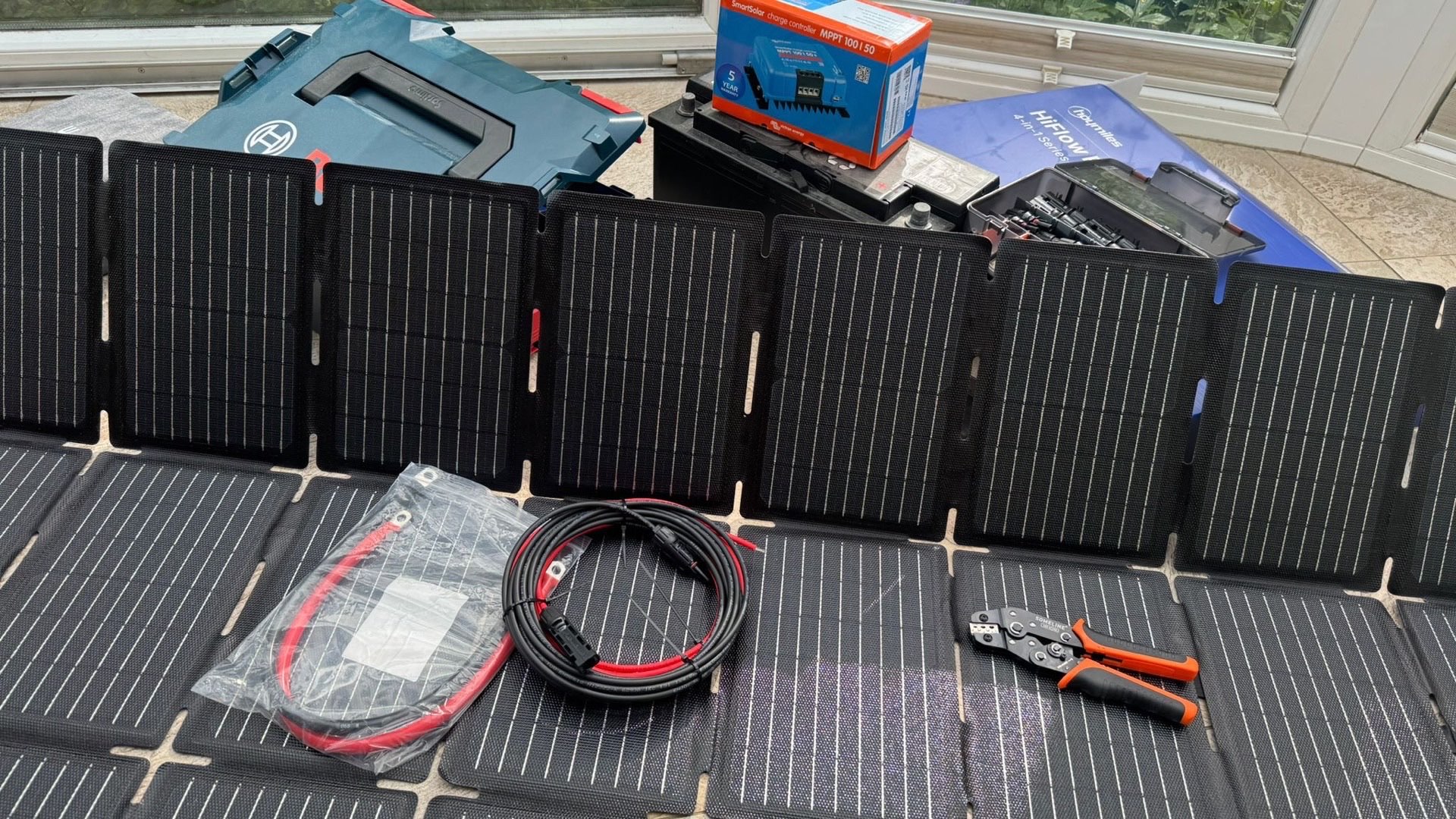
My 2000W DIY solar setup with LiFePO4 leisure battery, Victron MPPT charge controller and a 400 W foldable panel for around £1,050 — built for more usable capacity and expandability than a similarly-priced pre-built, not for beating one on a 2 kWh sticker price. Complete UK bill of materials, step-by-step wiring, and an honest side-by-side with EcoFlow DELTA 3 Plus and Jackery Explorer 2000 v2.
Transparency: links marked (*) are affiliate links — if you buy through them we may earn a commission at no extra cost to you. It doesn't change our recommendations.
Last updated: May 2026 · Product prices and ASINs last verified on 2026-05-22. Related guide: Octopus Agile battery arbitrage setup.
I had one of those moments scrolling online. You know the one. I saw the price for a big-name 2 kWh power station and nearly spat out my tea. Over £1,700. For my shed! I just wanted to run my power tools, charge my e-bike, and keep a small fridge going at the allotment without running a massive extension lead from the house.
That price tag sent me down a rabbit hole. I started wondering, “What’s actually inside these magic boxes?” Turns out, it’s five basic components — and a proper solar panel is the part that really makes it pay back. When I priced them up individually, the total came to less than £900: a LiFePO4 leisure battery, an MPPT solar charge controller, a 400 W foldable solar panel, a 2000 W pure-sine inverter and a cable + ANL-fuse kit. So I took a punt, spent an afternoon with a crimper and a drill, and built my own DIY solar power system. Here’s exactly what I bought, how I wired it, the massive mistake I made along the way, and why I’m never going back.
To be clear: I’m not building a portable power station with a handle and a screen. I’m building a modular DIY solar system — a battery, an inverter, an MPPT charge controller, solar panels and safe wiring — permanently fitted in one spot. A power-station alternative for a shed, garage, allotment, off-grid cabin or a permanently-fitted motorhome build.
⚠️ Safety disclaimer: This article shares my personal experience with a DIY solar setup. Descriptions may be incomplete or inaccurate, and products change constantly. You build at your own risk. Working with 12V/24V LiFePO4 batteries, 2000W inverters and 230V AC wiring requires basic electrical knowledge. If you’re not confident with DC/AC wiring, fuse sizing, RCD installation or earthing, hire a qualified electrician — cable fires and electrical injuries are real. For any installation tied to the grid (e.g. hybrid inverter), the work must comply with G98/G99 and be signed off by an MCS-certified installer.
You’re here because you’re torn between “I’ll build it myself” and “I’ll just buy a finished box.” This decision table answers it in 5 seconds:
| Your situation | Better choice |
|---|---|
| Shed, garage or allotment (stationary) | DIY solar setup |
| Permanent motorhome / van build | DIY or hybrid all-in-one |
| Weekend camping, market stalls, festivals | Pre-built (EcoFlow / Jackery) |
| Home-office UPS for outages | Pre-built (UPS switchover) |
| Maximum kWh per pound | DIY solar setup |
| Maximum comfort + app + warranty | EcoFlow / Jackery |
| Off-grid cabin with future expansion | DIY solar setup |
| Crimping wires sounds terrifying | Pre-built |
If your answers lean “stationary + max capacity,” keep reading — the rest of this article is your build guide. If you’re more “mobile + comfort,” scroll down to the pre-built recommendations section.
My goal was simple: 2000 watts of proper 230V AC power, at least 2 kWh of solar-charged storage, and a 400 W foldable panel to top the battery up on a decent British day. I wanted it permanently fitted in my workshop, safe and solid. Here’s how my DIY solar build stacks up against the off-the-shelf power stations.
| Feature | DIY Budget (200Ah / 12V) ★ Recommended | DIY Premium (2× 280Ah, 24V) | EcoFlow DELTA 3 Plus | Jackery Explorer 2000 v2 |
|---|---|---|---|---|
| Price | ~£1,050 | ~£1,500 | £699 | £1,061 |
| Capacity (nominal) | 2.56 kWh / ~2.0 kWh usable | 7.2 kWh / ~5.7 kWh usable | 1.02 kWh (expandable to 5 kWh) | 2.04 kWh |
| Continuous output | 2000W (4000W surge) | 2000W (4000W surge) | 1800W (X-Boost 2400W) | 2200W |
| Solar input | up to 700W (Victron 100/50) | up to 1400W (Victron 100/50, 24V) | 1000W | 1400W |
| Mobility | Stationary | Stationary | Portable (12.5 kg) | Portable (17.5 kg) |
| Warranty | 5–10 yrs per component | 5–10 yrs per component | 5 years | 5 years |
| App control | Optional (VictronConnect) | Optional (VictronConnect) | Yes (EcoFlow app) | Yes (Jackery app) |
The pre-built power stations win on portability, UPS and polish. On usable kWh per pound, DIY pulls ahead as you scale: a budget DIY build (~£1,050) gives about 2.5× the storage of the equivalent-budget DELTA 3 Plus, and premium DIY at ~£1,500 offers nearly 3× the capacity of any same-price pre-built. Need more later? Add another battery — try doing that with a sealed box. At the bare 2 kWh tier, though, a discounted Jackery is comparable on price.
Short answer: Below 2000 W continuous → 12 V (cheaper components, broadest UK hardware availability, simpler wiring). Above 2000 W or with long DC runs → 24 V (current halves, so you can use much thinner copper and smaller fuses — easily £50–100 less cable on a typical build). Both feed 230 V via the inverter; the trade-off sits entirely on the DC side.
This is the heart of the system, and the one place you absolutely shouldn’t skimp. For me, it had to be LiFePO4 (LFP), no ifs or buts.
The bigger question: 12V or 24V?
Rule of thumb: Up to 1000W, 12V is fine. At 2000W or more, 24V wins. Why?
| Load | 12V current | 24V current | Cable recommendation |
|---|---|---|---|
| 1000W | ~83 A | ~42 A | 16 mm² (12V) / 6 mm² (24V) |
| 2000W | ~167 A | ~83 A | 50 mm² (12V) / 16 mm² (24V) |
| 3000W | ~250 A | ~125 A | 70 mm² (12V) / 25 mm² (24V) |
At 2000W, 24V halves the current from ~167A to ~83A. In practice: instead of £60–£80 for 50 mm² copper, 16 mm² runs you £15–£20 — and the fuse is cheaper. If you’re starting fresh today, I’d pick 24V almost every time. More on this: 12V or 24V in detail.
Concrete picks (all on Amazon.co.uk):
In all cases: built-in BMS non-negotiable. LiTime / Renogy / Eco-Worthy / Bluetti are safe bets. No-name third-party Amazon batteries: skip them.
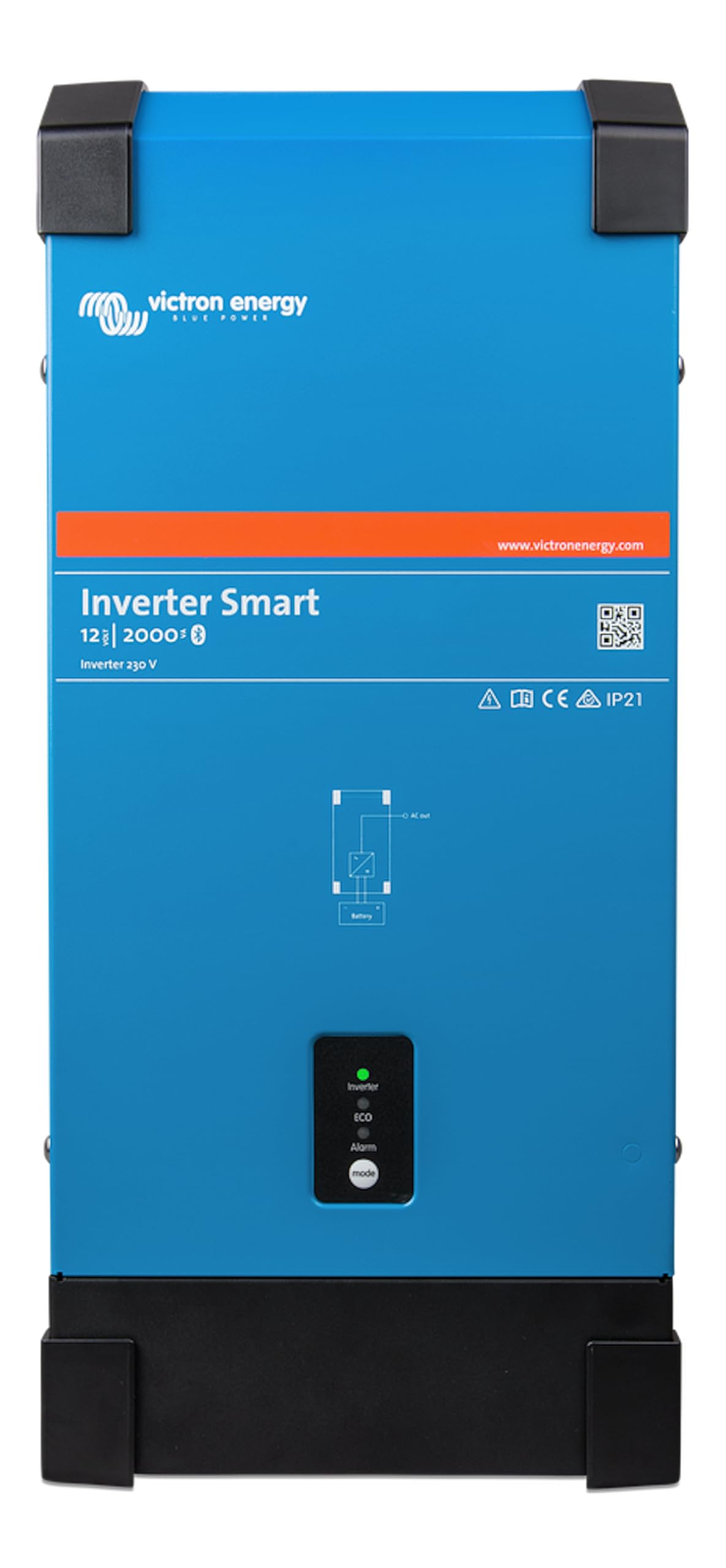
Short answer: Pure sine wave only — modified sine kills laptop chargers and smart-appliance controls. For 12 V/2000 W, the Renogy 2000 W pure-sine (~£220) is the value pick; for 24 V the Victron MultiPlus or the Renogy 24 V variant. Mandatory: a Class-T fuse at the battery (LiFePO4 has very high short-circuit current; Mega/ANL often won’t safely break it) and 50–70 mm² copper.
Trust me on this one: pure sine wave only. You’ll see cheaper “modified sine wave” inverters, and they might seem tempting. They’re fine for simple stuff like an old incandescent bulb, but they’ll slowly murder anything with sensitive electronics. Laptop chargers, modern power tool batteries, speakers, LED lights – they all hate it.
In the UK market I’d narrow your choice to two tiers:
⚠️ Wiring warning — expert tip: A 2000W inverter pulls over 160 amps at max load on a 12V system. Never use the thin cables that ship with budget inverters. For this power level you need 50 mm² copper cable minimum and a solid ANL or mega-fuse rated 200–300A mounted directly at the battery’s positive terminal. Skip this and your cables turn into heating elements — see my mistake further down.
A few things I looked for in my inverter:
My biggest tip: wire the inverter directly to the battery with the thickest, shortest cables possible. Never, ever wire it through the solar charge controller’s load terminals. Keep the battery-to-inverter run under 1.5 metres using 50 mm² cable.
Short answer: MPPT is mandatory once panel power exceeds 200 W — 15–30% more yield over PWM, and the gap widens further in Britain’s dim winter sun. For 400–600 W of solar, a Victron SmartSolar MPPT 100/30 (~£130) or Renogy Rover 30A is the standard pick. Sizing rule: panel V_OC × 1.25 must stay under the controller’s max input (a 36 V V_OC module × 1.25 = 45 V → a 75 V controller is enough).
This little box is the go-between for your solar panels and your battery. You’ll see two types: PWM and MPPT. Don’t even hesitate. MPPT (Maximum Power Point Tracking) is what you want. It’s clever enough to squeeze 15-30% more power out of your panels on any given day, which makes a huge difference during our less-than-glorious British winters.
Sizing it is crucial. You need to look at your solar panel’s “Open Circuit Voltage” (V_OC).
| Panel V_OC | MPPT model |
|---|---|
| up to 60V | Victron 100/30 or 100/50 |
| up to 100V | Victron 150/50 or Eco-Worthy 100/60 |
| up to 150V | Victron 250/60 (series-string of panels) |
Here’s the golden rule I learned the hard way on a previous project: Your panel’s V_OC multiplied by 1.25 must be less than the controller’s maximum input voltage. On a bright, freezing cold morning, panel voltage can spike way above its rating, and if your controller isn’t sized to handle it, you’ll hear a sad little pop and smell magic smoke. Background: MPPT vs. PWM and correct sizing.
Concrete picks:
You’ve got two main choices here, and it really depends on your setup.
For my stationary workshop, rigid panels were a no-brainer. One bit of advice: if you’re using multiple panels and there’s any chance of one being partially shaded (by a tree, another building, etc.), wire them in parallel, not series.
Concrete picks:
This is the boring bit, but it’s what separates a safe, reliable system from a fire hazard. Getting this right is non-negotiable. Here’s my minimum shopping list:
You can buy these bits separately, but I found a kit on Amazon for about £80 that had everything. The one thing you must never, ever skip is that main battery fuse. A dead short on one of these batteries without a fuse is… explosive.
I laid everything out on the bench before I mounted it to the wall. It helps to see it all. Here’s the order I connected everything:
To power it up for the first time, I flipped the main battery switch on, watched the MPPT controller wake up, and only then did I turn on the inverter. Powering down is the exact reverse.
I’d be lying if I said it all went perfectly first time. My big mistake was with the cables connecting the battery to the inverter. I had some 35 mm² cable left over from another project, and thought, “That’ll be good enough, it’s only a metre long.”
It wasn’t.
The first time I properly tested the system, I plugged in my 1800W kettle. The inverter hummed, the kettle started to heat up… and then the inverter’s low-voltage alarm started screaming and it shut down. I was baffled. The battery was fully charged. I tried again. Same thing. Then I noticed a faint smell of hot plastic. I put my hand on the big red cable and it was roasting hot.
What I’d completely failed to appreciate was voltage drop. At 12V, a 2000W load is pulling over 160 amps. My “good enough” cable was acting like a resistor, turning precious battery power into heat. The voltage was dropping so much before it even reached the inverter that the inverter thought the battery was flat.
The biggest lesson I learned: Don’t guess with cable sizes. I immediately ordered proper 50 mm² pre-crimped cables. The difference was night and day. The kettle boiled without a single beep from the inverter, and the cables stayed completely cool. It was a stupid, dangerous mistake, but one I’ll never make again. The numbers are there for a reason.
Look, as much as I love my DIY setup, I’m not a complete zealot. There are definitely times when I’d still tell a friend to buy an EcoFlow or Jackery off the shelf.
For pretty much any other fixed scenario – your shed, allotment, garage, a permanent motorhome installation – I believe DIY wins by a country mile.
Here’s my UK bill of materials with direct Amazon.co.uk links. Sequence is exactly how I assembled it:
Pre-built power stations as an alternative:
A note on availability: If a main pick is sold out, the alternatives I listed in each component section above are direct drop-in replacements — same safety class, similar performance, similar price range. Links marked with (*) are affiliate links; no extra cost to you.
So, should you build your own? For me, the answer is a resounding yes.
Go DIY if:
Buy a power station if:
The choice was simple for me. I now have a beast of a system in my workshop that cost less than half of a big-brand equivalent. And for weekend trips? I picked up a small Jackery Explorer 500 v2. The best of both worlds, and the combined cost was still less than one of those monster 2 kWh pre-built units.
Power Queen
£349.99
Prices & availability may change.

Renogy
£249.99
Prices & availability may change.
Victron Energy
£524.99
Prices & availability may change.

£137.28
Prices & availability may change.

£399.99
Prices & availability may change.

£16.99
Prices & availability may change.

£699.00
Prices & availability may change.

Jackery
£1,061.00
Prices & availability may change.
Stationary use — yes, and usually cheaper with more usable capacity. For mobile use (weekends away, festivals, market stalls), app ecosystems and millisecond UPS switchover, pre-built power stations like the EcoFlow Delta 3 or Jackery Explorer 2000 v2 are still more practical. My rule of thumb: if the setup lives in one spot (shed, allotment, permanent motorhome build), DIY wins. If you move it every couple of weeks, the pre-built box wins.
For short bursts you can get away with less, but a sensible minimum is 2 kWh usable — meaning 200 Ah at 12V or 100 Ah at 24V. For continuous 2000W loads I lean 24V: the current roughly halves (~80A vs 160A), so cables and fuses get cheaper and voltage drop shrinks for the same cable. For longer off-grid stays, parallel two LiFePO4 batteries through a shared BMS.
Yes — if you want your panels to actually charge the battery efficiently. A PWM controller wastes 15–30% of harvested power because it discards panel voltage above the battery voltage. MPPT (Maximum Power Point Tracking) reclaims that energy, which matters even more in the UK's dimmer winter sun. The critical sizing rule: the MPPT's max input voltage must exceed your panel's open-circuit voltage × 1.25. The Victron SmartSolar 100/50 is my go-to for 12/24V builds.
For small mobile use under 1 kWh, a pre-built unit is often cheaper and easier. As you scale up, DIY wins on £/kWh: a 2.56 kWh DIY build runs ~£1,050, while the EcoFlow DELTA 3 Plus (1,024 Wh) is £699 — about 2.5× the storage for ~50% more, with room to expand. A 7.2 kWh DIY build with twin 280Ah packs runs ~£1,500, and a pre-built of that size is rare under £2,500. At the bare 2 kWh tier, though, a discounted Jackery is comparable on price.
With proper fusing — an ANL fuse at the battery positive terminal and an RCD breaker on the inverter AC output — and a certified LiFePO4 battery with built-in BMS, a DIY setup can be very safe. But unlike a brand-name power station it isn't a factory-tested, listed system, so safe assembly is on you. Three things matter most: a certified BMS, a fuse sized to your cable and the inverter's surge (commonly ~300A for a 2000W 12V build), and correct cable cross-section (50 mm² at the inverter input on a 12V system).
Component total is around £1,050: a 200Ah/12V LiFePO4 with a 200A BMS (~£350) + 2000W pure-sine inverter (~£250) + Victron MPPT 100/50 (~£137) + 400W foldable solar panel (~£400) + a proper cable, ANL fuse and disconnect kit (~£80 — not just a £17 fuse holder). EcoFlow's UK lineup centres on the DELTA 3 Plus (£699, 1,024 Wh) — much smaller capacity than a DIY 2.56 kWh build. The Jackery Explorer 2000 v2 (£1,061, 2,042 Wh) is the closest pre-built, similar price for ~20% less capacity and no expansion path.
Amazon.co.uk is usually competitive and convenient for LiTime, Renogy, Eco-Worthy, BougeRV and Victron components, often 10–20% below manufacturer-direct — but compare before you buy. Watch for Prime Day and Black Friday: 200Ah LiFePO4 batteries drop toward £329 during major sales. Buying through Amazon also means a simple UK-based returns path if a component arrives faulty.
Be realistic: 400Wp in 4–5 summer peak-sun hours yields only about 1.6–2 kWh per clear day after losses — less than one full charge of a 2.56 kWh battery, and 200Wp is half that. In winter (Nov–Feb), with just 1–2 peak hours, solar alone won't fully recharge daily use. For year-round autonomy: 600W+ of panel plus a B2B charger from a vehicle alternator, or grid top-up where available.
Two non-negotiable rules: (1) inverter and battery must share the same system voltage (12V or 24V — pick 24V for 2000W+ to halve the cable current). (2) MPPT charge controller's max input voltage must exceed panel V_OC × 1.25. Mixing voltages or undersizing the MPPT input range will void warranties or fry the controller on a sub-freezing sunny morning.
For pure off-grid use (no grid export) — no. If you connect the battery to a grid-tied solar system or want to back-feed via a hybrid inverter, the installation must comply with G98/G99 and you'll need an MCS-certified installer. Stand-alone shed/allotment setups are unrestricted.
Keep Reading
Power & Energy
12V or 24V for a 2000W inverter? We compare current draw (~170A vs ~85A), cable size in mm², cost and efficiency — and when 12V is fine vs. when 24V is the clearly better choice.
Mobile
The best budget smartphones in the UK for 2026: Google Pixel 10a (7 years of updates), Samsung Galaxy A57 (6 years), Nothing Phone (4a) Pro as the British-brand hero, and the £219 CMF Phone 2 Pro under £250 — with PSTI Act minimum-support-period context.
Power & Energy
What cable size for a 2000W inverter? At 12V the real draw is ~180–200A — we show why 50 mm² is the bare minimum (70 mm² is safer), how to size the fuse and voltage drop, and how to avoid cable fires.