MPPT vs. PWM Solar Charge Controller: Difference, Efficiency and Which Is Worth It
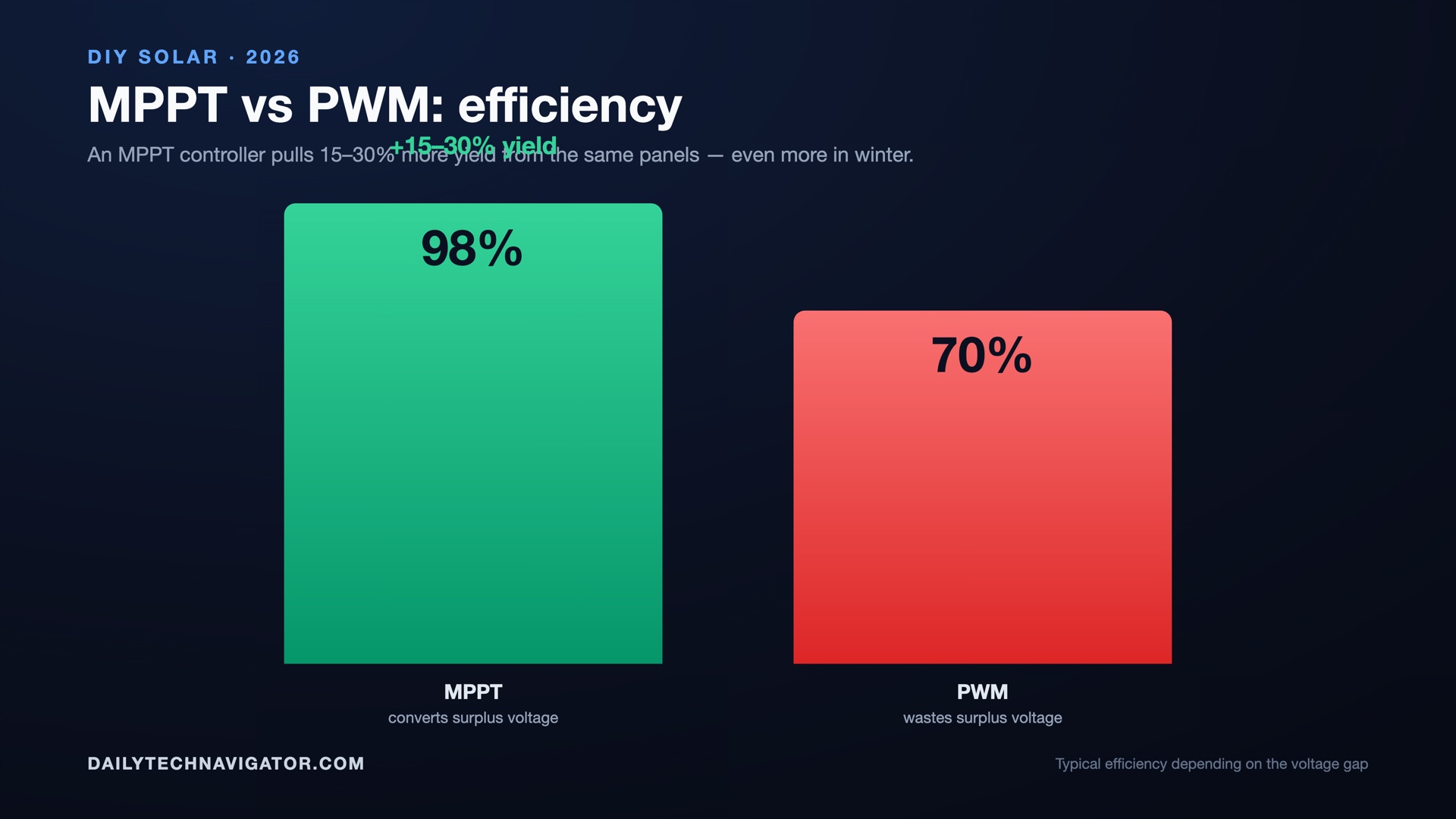
MPPT or PWM? We explain the difference, the efficiency (PWM roughly ~70% vs. MPPT up to ~98%) and when the pricier MPPT controller is worth it — including the important V_OC × 1.25 sizing rule.
Transparency: links marked (*) are affiliate links — if you buy through them we may earn a commission at no extra cost to you. It doesn't change our recommendations.
Last updated: May 2026 · Part of our 2000W DIY solar setup.
At the charge controller you face exactly two options: PWM or MPPT. The difference sounds technical, but it decides how much of your solar yield actually reaches the battery.
Short answer
An MPPT controller extracts up to ~30% more yield from the same panels than a PWM controller and is worth it in practice from about 400W of panel — all the more in the UK’s weaker winter sun. A PWM controller only makes sense on very small arrays (< ~150W). For a DIY solar setup with 400W or more, MPPT is the clear choice.
How PWM works
PWM (pulse-width modulation) is essentially a fast switch between panel and battery. It pulls the panel voltage down to the battery voltage — the difference is lost as unused energy. How big that loss is depends on the voltage gap; roughly, PWM lands around 70%.
How MPPT works
MPPT (Maximum Power Point Tracking) constantly finds the panels’ optimal operating point and converts the surplus voltage into extra charging current instead of wasting it. Almost all the harvested energy is kept — peak efficiencies up to ~98% (Victron) are possible.
Efficiency & extra yield
| PWM | MPPT | |
|---|---|---|
| Principle | pulls voltage down | converts voltage to current |
| Efficiency | roughly ~70% (depends on voltage gap) | up to ~98% |
| Extra yield | – | up to ~30% |
| Best for | small arrays < ~150W | from ~400W, cold/dim conditions |
| Price | cheaper | pricier |
The MPPT lead is largest when it’s cold and when panel voltage sits well above battery voltage — exactly the conditions on a clear winter day.
Sizing rule: V_OC × 1.25
The key rule when buying: the controller’s maximum input voltage must exceed your panels’ open-circuit voltage (V_OC) × 1.25. On cold, sunny days panel voltage can briefly spike — without that headroom you risk the controller. A Victron SmartSolar 100/50 (100V max) covers panels up to ~80V V_OC. This is a simplified rule of thumb; in very cold conditions, calculate the maximum voltage from the module’s temperature coefficient.
When PWM still makes sense
For the common middle ground — a 200–300W array — MPPT is still the better pick in most cases, all the more in Britain’s dim winter light; choose PWM only if budget is the deciding factor. Only on very small setups (trickle charging, a single panel < ~150W) is PWM a clear-cut saving. As soon as yield matters, the MPPT premium pays for itself quickly.
How the controller fits the whole system — with battery, inverter and wiring — is in our 2000W DIY solar setup. See also: 12V or 24V? and cable size for a 2000W inverter.
FAQ
What's the difference between MPPT and PWM? +
A PWM controller is essentially a switch that pulls the panel voltage down to the battery voltage — the excess voltage is lost. An MPPT controller converts that excess voltage into extra charging current, getting noticeably more out of the panels.
How much more yield does MPPT give? +
Up to about 30% more than PWM, depending on conditions. How big the PWM loss is depends on the gap between panel and battery voltage; roughly, PWM lands near 70% while a good MPPT reaches up to ~98% (Victron rates the SmartSolar 100-series at max 98%). The edge is biggest in the cold and when panel voltage sits well above battery voltage.
At what wattage is MPPT worth it? +
Rule of thumb: from about 400W of panel, the extra yield offsets the higher cost — and it matters even more in Britain's dimmer winter sun. Below that, on very small arrays (< ~150W), a cheap PWM controller is usually fine.
How do I size the MPPT input voltage (V_OC × 1.25)? +
The controller's maximum input voltage must exceed your panels' open-circuit voltage (V_OC) × 1.25. On cold, sunny days panel voltage briefly rises — that headroom protects the controller. It's a simplified rule of thumb; in very cold conditions, calculate the max voltage from the module's temperature coefficient.