Cable Size for a 2000W Inverter: Getting 50–70 mm² Right at 12V
What cable size for a 2000W inverter? At 12V the real draw is ~180–200A — we show why 50 mm² is the bare minimum (70 mm² is safer), how to size the fuse and voltage drop, and how to avoid cable fires.
Transparency: links marked (*) are affiliate links — if you buy through them we may earn a commission at no extra cost to you. It doesn't change our recommendations.
Last updated: May 2026 · Part of our 2000W DIY solar setup.
The most common — and most dangerous — way to save money on a DIY solar build is undersizing the cable between battery and inverter. This run carries the highest current in the whole system, and it’s exactly where people cut corners.
Short answer
For a 2000W inverter at 12V, plan on 50–70 mm² copper: 50 mm² only for runs under ~1.5 m, and 70 mm² as the safe choice for the real ~180–200A. At 24V you can drop to about 25 mm² (16 mm² only for very short runs). Add a fuse (250–300A) right at the battery positive — for a LiFePO4 battery a Class-T fuse is the safer pick because it interrupts the very high short-circuit current that Mega/ANL fuses may not. Mount it as close as practicable and keep the run short.
Where the high current comes from
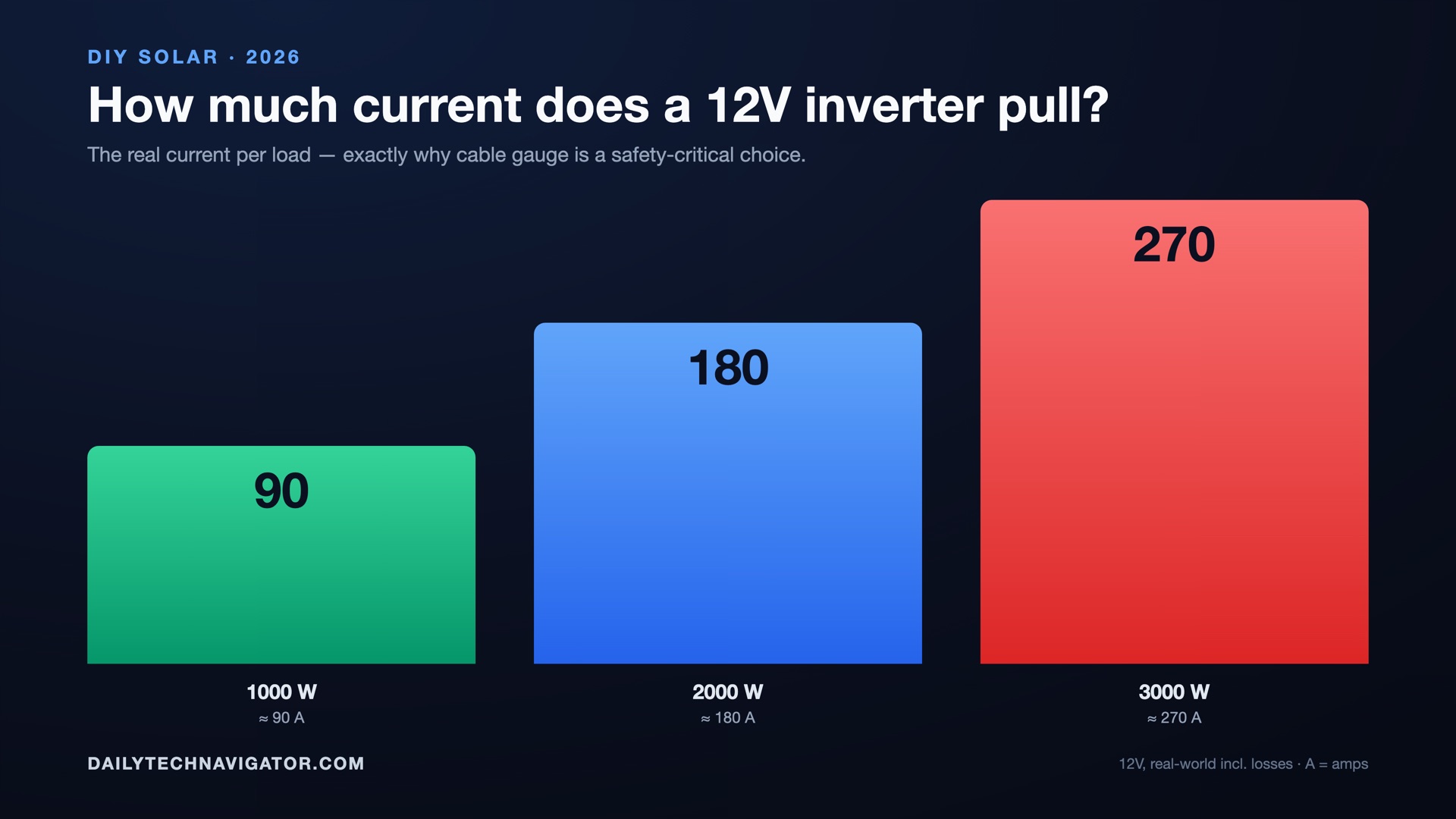
A 2000W inverter pulls ~167A at 12V on paper — and with efficiency and voltage sag under load, 180–200A in the real world. Your cable has to carry that continuously without meaningful heating.
| Load (12V) | Real current | Cross-section (short runs) |
|---|---|---|
| 1000W | ~90A | 25 mm² |
| 2000W | ~180–200A | 50–70 mm² (70 mm² safe) |
| 3000W | ~270A | 95 mm² |
At 24V the current halves, so the cross-section does too (~25 mm² for 2000W). The figures assume short runs and a low voltage-drop target (~3%); for longer runs, go up a size — use a calculator for your exact length. Why 24V often pays off above 2000W is in our 12V or 24V guide.
Voltage drop & short runs
The thinner the cable and the longer the run, the bigger the voltage drop — aim to keep it well under ~3% (ideally ~1% on the main run). In practice: mount the inverter right next to the battery and keep the run short; if it’s more than ~1.5 m away, go one size up. Use an online calculator for your exact length.
Don’t skip the fuse
A high-current fuse belongs right at the battery positive. It protects the cable in a short circuit — not the inverter. For a LiFePO4 battery, a Class-T fuse is the safer pick: it interrupts the very high fault current a lithium battery can deliver, where Mega/ANL fuses may fall short. Size it to your cable’s rating and continuous load; 250–300A is typical for a 50–70 mm² 12V/2000W build. Mount it as close to the terminal as practicable, or the stretch before it is unprotected.
Copper, not CCA
Use pure copper (OFC). Cheap “CCA” cable (copper-clad aluminium) carries noticeably less current per mm² — the inverter run is the wrong place to save. If you do use CCA, size up.
The full build — battery, inverter, MPPT and wiring in the right order — is in our 2000W DIY solar setup. See also: 12V or 24V? and MPPT vs. PWM.
FAQ
What cable size for a 2000W inverter at 12V? +
Plan on 50 mm² for runs under ~1.5 m and 70 mm² as the safe choice for the real ~180–200A. If the inverter is more than ~1.5 m from the battery, go one size up. Size it for your exact length with a calculator.
Is 35 mm² enough for a 2000W inverter? +
No. 35 mm² is too small for the ~170–200A a 12V/2000W inverter pulls. It overheats, voltage drop spikes and the inverter shuts down on low voltage. Use 50–70 mm², or move to 24V.
What fuse goes on the battery cable? +
A fuse right at the battery's positive terminal — commonly 250–300A for a 12V/2000W setup. For a LiFePO4 battery a Class-T fuse is the safer choice (high interrupting capacity); Mega/ANL may not safely break the very high short-circuit current. The fuse protects the cable, so match it to the cable's current rating.
How close to the battery does the fuse need to be? +
As close as practicable — keep the unprotected stretch as short as possible. The longer the cable before the fuse, the higher the short-circuit risk.
Copper or copper-clad aluminium (CCA)? +
Use pure copper (OFC) for the battery-to-inverter run. CCA carries far less current per mm²; if you do use it, size up.