Octopus Agile Explained: Half-Hourly Pricing, Plunge Rates and How a Battery Profits
Octopus Agile explained: prices change every half hour, the 4–7 PM peak can top 30p and overnight can go negative. We show how the tariff works and how a plug-in battery profits from the swings — realistically.
Transparency: links marked (*) are affiliate links — if you buy through them we may earn a commission at no extra cost to you. It doesn't change our recommendations.
Last updated: May 2026 · Part of our Octopus Agile battery arbitrage guide.
Octopus Agile is the tariff that makes a home battery genuinely interesting in the UK — because the price you pay changes every half hour, and sometimes goes below zero.
Short answer
Agile sets a new unit price every 30 minutes, published a day ahead from wholesale prices. Overnight (roughly 2–5 AM) is cheap — occasionally negative — while the 4–7 PM peak can top 30p/kWh. A plug-in battery profits by charging cheap and discharging at peak. Be realistic about the size: a 1 kWh battery saves on the order of £90/year, more with a bigger unit or negative-price nights.
How half-hourly pricing works
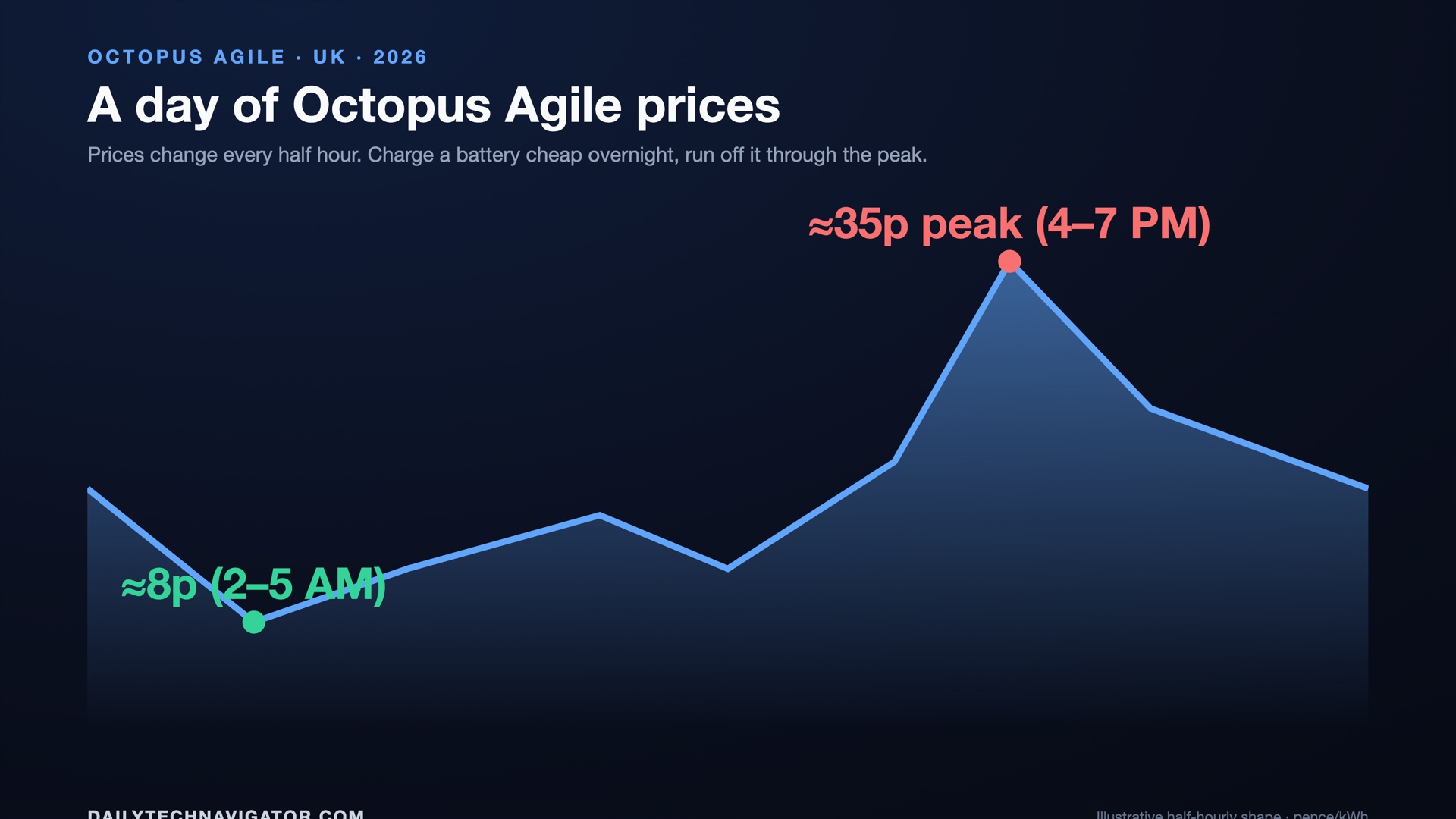
Standard tariffs charge one flat unit rate all day. Agile instead publishes 48 prices a day — one per half-hour slot — set the afternoon before, tracking the wholesale market. So the same kWh can cost 8p at 3 AM and 35p at 5 PM.
Peak, cheap and negative
- Cheap: overnight (~2–5 AM) and often around midday, when demand is low or wind is high.
- Peak: the 4–7 PM evening crunch, the dearest slots of the day — regularly above 30p/kWh and sometimes 35p+ in winter, while the cheapest overnight slots often sit at 15–20p.
- Plunge / negative pricing: on very windy nights, wholesale prices can go below zero and Agile passes it through — you’re effectively paid to use power.
How a battery profits
The play is simple arbitrage: charge the battery during the cheap (or negative) slots, then run your home off it during the expensive peak. A smart plug or the battery’s own scheduler automates the timing — set it once and forget it. The bigger the price swing, the bigger the win.
Realistic savings
Keep expectations grounded. A 1 kWh battery cycled once a day across a ~25p spread shifts about 1 kWh, which is roughly £90/year; a 2 kWh unit run fully roughly doubles that. Negative-price nights add a little on top. It’s a dependable, hands-off saving — not a get-rich scheme — and payback runs to several years on a modest kit.
The full plug-and-play setup — which battery, how to schedule it, no DNO paperwork — is in our Octopus Agile battery arbitrage guide.
FAQ
How does Octopus Agile pricing work? +
Agile sets a different unit price for every half-hour slot, published a day ahead and based on wholesale power prices. So your rate at 3 AM can be a fraction of your rate at 5 PM on the same day.
What is plunge (negative) pricing? +
When there's more renewable generation than the grid can use — often windy nights — wholesale prices go negative, and Agile passes that through. On those slots you're effectively paid to use power.
When is Agile cheapest and most expensive? +
Cheapest overnight (roughly 2–5 AM) and around midday; most expensive in the 4–7 PM peak, which can top 30p/kWh in winter. The exact slots change daily.
Can a battery actually save money on Agile? +
Yes, but be realistic. A 1 kWh battery cycled once a day at a ~25p spread saves on the order of £90/year (more with a bigger battery or negative-price nights). It's a steady saving, not a windfall.
Is there a price cap on Agile? +
Agile has historically had a per-unit cap (around £1/kWh) so a single bad slot can't run away. Check Octopus's current cap, as it can change.