12V or 24V? Choosing the Right System Voltage for a 2000W Inverter
12V or 24V for a 2000W inverter? We compare current draw (~170A vs ~85A), cable size in mm², cost and efficiency — and when 12V is fine vs. when 24V is the clearly better choice.
Transparency: links marked (*) are affiliate links — if you buy through them we may earn a commission at no extra cost to you. It doesn't change our recommendations.
Last updated: May 2026 · Part of our 2000W DIY solar setup.
One of the first decisions in a DIY solar build is the system voltage: 12V or 24V? It sounds minor, but it drives your cable size, fuses, cost and safety.
Short answer
Up to about 1000W continuous, 12V is perfectly fine. At 2000W or more, go 24V: the same power then flows at half the current (~85A instead of ~170A), so cables and fuses get much thinner, cheaper and safer. If you’re building fresh and planning 2000W+, 24V is almost always the better call.
The real issue is current
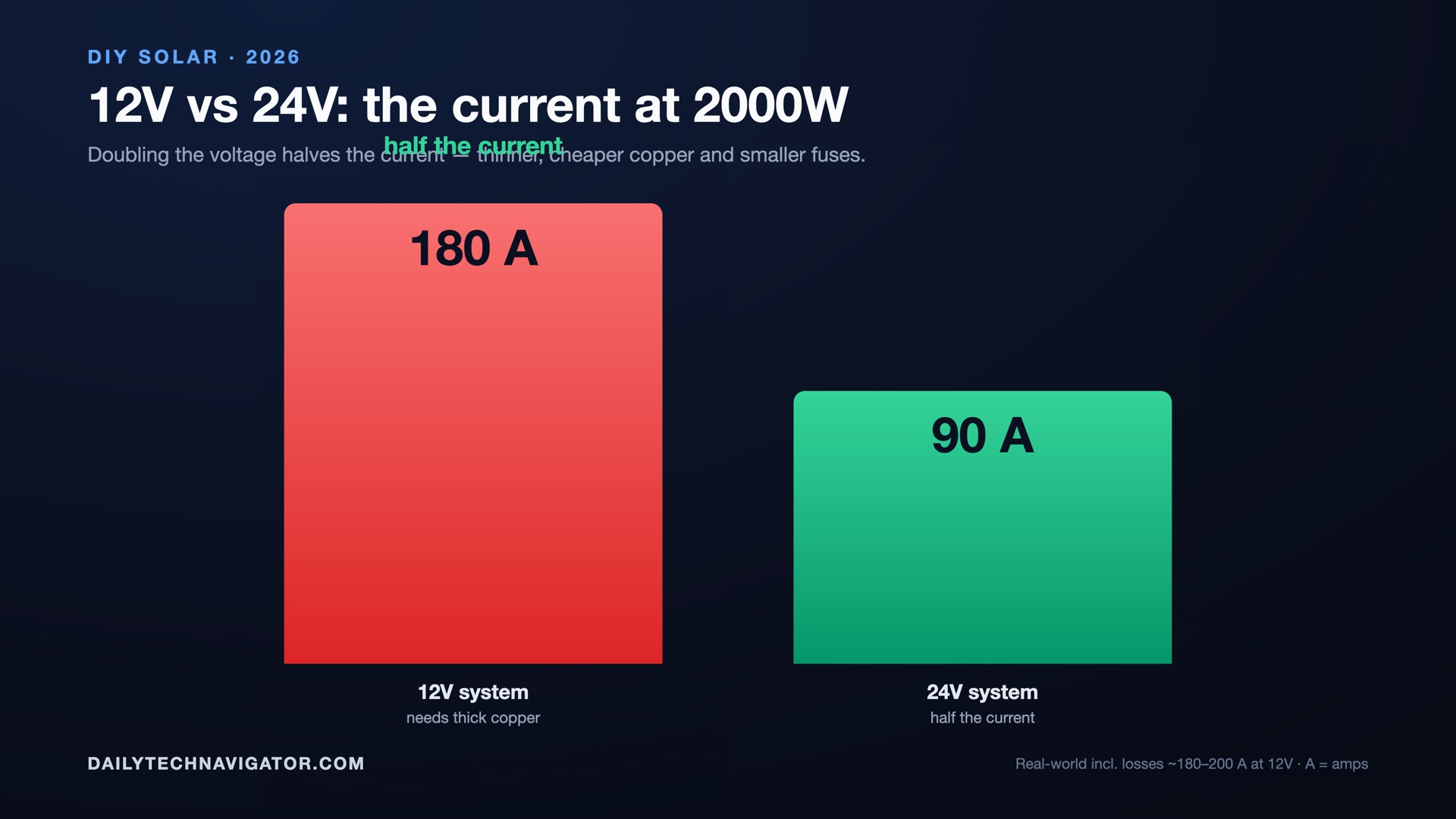
Power = volts × amps. At the same power, doubling the voltage halves the current — and current decides how thick your cable must be.
| Load | Current at 12V | Current at 24V | Cable (12V / 24V) |
|---|---|---|---|
| 1000W | ~83A | ~42A | 25 mm² / 6–10 mm² |
| 2000W | ~170A | ~85A | 50–70 mm² / 16–25 mm² |
| 3000W | ~250A | ~125A | 95 mm² / 35 mm² |
These are the theoretical minimum currents. In practice the real draw runs ~10–15% higher (inverter efficiency + voltage sag), so for 2000W at 12V plan on 180–200A — and 70 mm² as the safe choice for anything but the shortest runs. More in our cable-size guide.
Cost & efficiency
Thinner cable means less copper and less money, plus slightly better efficiency because voltage drop falls with lower current. The catch: at 24V your battery, inverter, MPPT controller and any 24V loads all have to match — while 12V accessories (the caravan/automotive world) are more common and often cheaper.
When 12V is fine — and when 24V is clearly better
- 12V: loads up to ~1000W, small mobile setups, lots of existing 12V gear.
- 24V: from ~2000W continuous, long cable runs, a fixed workshop or off-grid cabin.
- 48V: worth it from ~3000–5000W — usually with ready-made hybrid systems rather than classic DIY.
Plan it right the first time
Switching from 12V to 24V later is a hassle: the batteries must be rated for series wiring, and the inverter and charge controller must support 24V. If you’re aiming for 2000W, save yourself the trouble and design in 24V from the start.
For the complete build — battery, inverter, MPPT controller and safe wiring step by step — see our 2000W DIY solar setup. Related: cable size for a 2000W inverter and MPPT vs. PWM.
FAQ
How much current does a 2000W inverter draw at 12V? +
About 2000W ÷ 12V ≈ 167A on paper. With inverter efficiency (~85–90%) and battery voltage sagging under load, the real draw is closer to 180–200A. That's why a 12V/2000W system needs very thick cable.
What cable size do I need at 12V vs 24V? +
For 2000W: at 12V plan on 50 mm² for runs under ~1.5 m and 70 mm² as the safe choice. At 24V you can drop to about 16–25 mm². See our cable-size guide for the full table.
Is 24V more efficient than 12V? +
Slightly. Half the current means lower losses and less voltage drop in the cable. The bigger practical win is the thinner, cheaper cable and fuses.
Can I convert a 12V system to 24V later? +
Only with limits. You'll need a 24V-capable inverter and MPPT controller, and the batteries must be approved for series wiring. If you're planning 2000W from the start, build in 24V.