US Best Overall
Shark
PowerDetect 2-in-1 Robot Vacuum
- ✓Best Overall — Tom's Guide 2026
- ✓Self-empty + auto-mop dock
- ✓PowerDetect adaptive cleaning
Current price & reviews on Amazon
Prices & availability may change.
The best robot vacuums in the US for 2026: Shark PowerDetect, Roborock Saros 20, Ecovacs Deebot N20 Pro and Roborock Qrevo Curv 2 Pro compared — with the dock as the deciding factor.
Transparency: links marked (*) are affiliate links — if you buy through them we may earn a commission at no extra cost to you. It doesn't change our recommendations.
Prices verified at amazon.com on June 1, 2026 — see Editorial Methodology for how we choose and refresh picks.
Affiliate disclosure: As an Amazon Associate we earn from qualifying purchases. If you click through and buy on Amazon, we receive a small commission at no additional cost to you. Commission rates don’t influence our picks.
Short answer: For most US buyers the Shark PowerDetect UV Reveal ($600–$1,000) is the best all-rounder — strong cleaning, a full self-emptying dock and easy availability. The Roborock Saros 20 is the pet-household pick (36,000 Pa, anti-tangle), the Ecovacs Deebot N20 Pro is the budget value pick, and the Roborock Qrevo Curv 2 Pro leads on deep carpet. But the deciding factor isn’t suction — it’s the dock.
That’s the editorial backbone here: suction and mopping among the top models are now nearly identical, and past 8,000 Pa the numbers are mostly marketing. The dock is what decides whether you run the robot daily or it becomes a chore after two weeks.
| Model | Price band | Suction | Dock | Mopping | Navigation | Best for |
|---|---|---|---|---|---|---|
| Shark PowerDetect UV Reveal | ~$600–$1,000 | high | full self-empty + mop wash | mop lift | lidar + AI obstacle | Best all-rounder |
| Roborock Saros 20 | ~$1,000–$1,400 | 36,000 Pa | omni (hot-water mop wash, dry) | lift + press-down | lidar + AI | Best for pet hair |
| Roborock Qrevo Curv 2 Pro | ~$900–$1,300 | very high | omni | lift + press-down | lidar + AI | Best for deep carpet |
| Ecovacs Deebot N20 Pro | ~$350–$500 | mid | self-empty | wet cloth | lidar | Best value / budget |
| Dyson Spot+Scrub Ai | ~$1,000–$1,300 | high | mop-focused dock | strong stain removal | AI | Best for mopping/stains |
Prices are bands at amazon.com as of June 1, 2026; they fluctuate daily and are re-verified each quarter.
Short answer: Because suction among top models is essentially the same (8,000+ Pa is plenty). The omni dock changes real life: auto-empty saves weekly bin emptying, automatic hot-water mop washing saves rinsing by hand, and water refill plus drying prevents a musty mop. A robot without a full dock asks you back to hands-on duty within a couple of weeks.
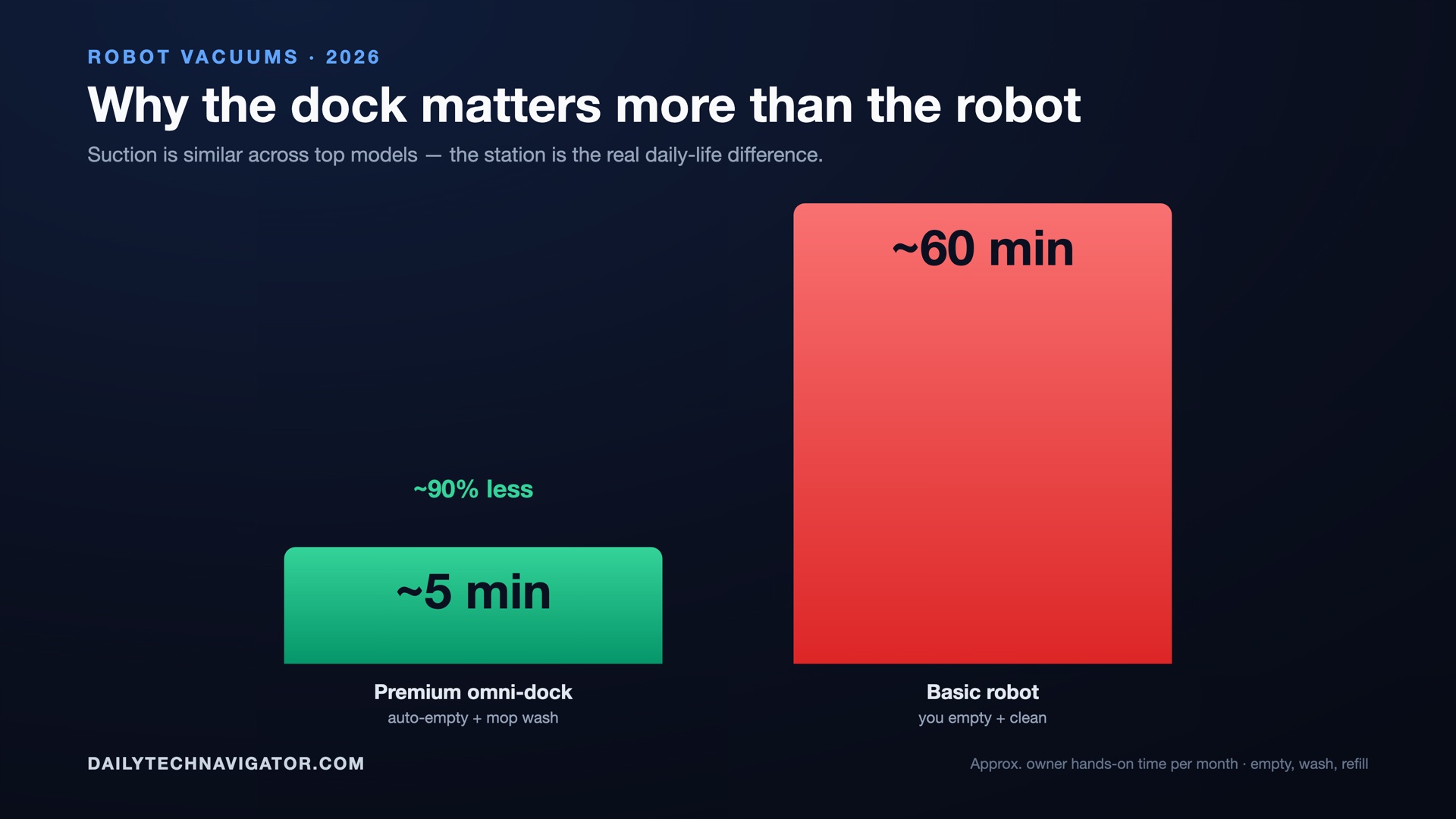
The math is the convenience lever: with a basic dock you fuss with it roughly 60 minutes a month (emptying, rinsing the mop, refilling); with a full omni dock it’s closer to 5 minutes. That’s what the premium pays for — not the last 10,000 Pa.
Short answer: Models with an anti-tangle rubber roller (not bristles) and strong suction. The Roborock Saros 20 (36,000 Pa, anti-tangle) leads for US pet households, with the Shark PowerDetect close behind and easy to buy at US retailers. With pets, automatic obstacle avoidance matters too so the robot steers around accidents — every top pick here does it.
US homes also tend to mix hardwood, tile and carpet, which is exactly where automatic mop lift earns its place — without it the robot drags a damp mop straight across the living-room rug.
A few things separate a robot you’ll run daily from one that ends up in a closet:
Short answer: We re-verify prices, availability and new models at the start of each quarter. This page shows price bands at amazon.com, not live prices — that keeps the data honest and complies with Amazon Associates policy. The current price appears when you click through to Amazon.
Our editorial methodology explains how we choose picks, which sources we weight, and what we deliberately don’t do (no in-house hands-on testing, no fabricated star ratings).
This guide covers the US market (amazon.com). For Germany see DE-Version; for the UK see en-GB version.
Shark
Current price & reviews on Amazon
Prices & availability may change.

Roborock
Current price & reviews on Amazon
Prices & availability may change.

TP-Link
Current price & reviews on Amazon
Prices & availability may change.
For most US buyers the Shark PowerDetect UV Reveal is the best all-rounder — strong cleaning, a full self-emptying dock and wide availability. The Roborock Saros 20 is the pick for pet households (36,000 Pa, anti-tangle), the Ecovacs Deebot N20 Pro is the budget value pick, and the Roborock Qrevo Curv 2 Pro leads on deep-carpet suction. Tom's Guide, RTINGS and Vacuum Wars converge on this shortlist.
Because suction among top models is essentially the same (8,000+ Pa is plenty for daily use). The dock is what changes real life: auto-empty saves weekly bin emptying, automatic hot-water mop washing saves rinsing by hand, and water refill plus drying prevents a musty mop. A robot without a full dock asks you back to hands-on duty within a couple of weeks.
Models with an anti-tangle rubber roller (instead of bristles) and strong suction win here. The Roborock Saros 20 (36,000 Pa, anti-tangle) leads for pets, with the Shark PowerDetect close behind and easy to buy at US retailers. Automatic obstacle avoidance also matters with pets so the robot doesn't drive through accidents — all the top picks here can do it.
Yes — but only if the mopping is actually good. Cheap units just drag a wet cloth. Modern top devices (Saros 20, Shark PowerDetect, Qrevo Curv 2 Pro) lift the mop on carpet, press down on hard floors with real force, and wash it at the dock with hot water. That replaces hand mopping; a wet cloth doesn't. For US homes with mixed hardwood, tile and rugs, mop lift is the feature that matters most.
For most US households, yes — especially with pets or frequent use. Self-empty docks cost more but save weekly bin emptying, and premium 'omni' docks add hot-water mop washing and water refill. The difference is between a robot you run daily and one that becomes a chore. Budget the dock first, the suction number second.
Check for automatic mop lift (or it drags a wet mop across carpet), lidar navigation plus AI obstacle avoidance, real 2 cm threshold climbing, noise (under 65 dB in standard mode), and the app's update record. Confirm replacement mops, dust bags and side brushes for your model are easy to get on amazon.com — that decides how long it stays in daily use.
Keep Reading
Power & Energy
12V or 24V for a 2000W inverter? We compare current draw (~170A vs ~85A), cable gauge, cost and efficiency — and when 12V is fine vs. when 24V is the clearly better choice.
Smart Home
The best 3D printers under $500 for US buyers in 2026: Bambu Lab A1, A1 Mini, Elegoo Centauri Carbon and Creality K1C compared, with picks and prices.
Power & Energy
How much battery for a PSPS outage? Shutoffs run 24–72 hours. We size it by load — fridge (~1–2 kWh/day), essentials, whole-home — and explain why solar recharge matters for multi-day outages.