US Best Espresso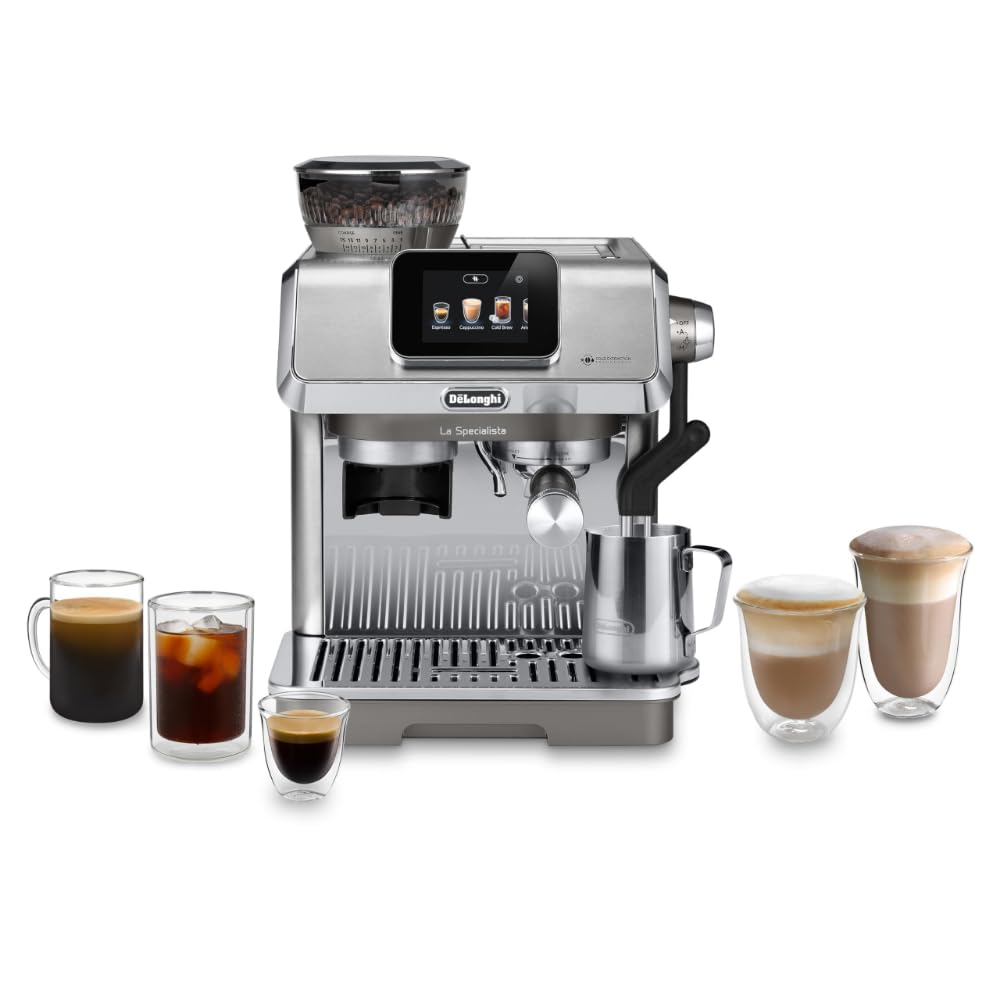
De'Longhi
La Specialista Touch
- ✓Best espresso machine — Tom's Guide
- ✓Built-in conical burr grinder
- ✓Auto micro-foam steam wand
Current price & reviews on Amazon
Prices & availability may change.
The best espresso machines in the US for 2026: De'Longhi La Specialista Opera, Breville Bambino, Breville Oracle Jet and Gaggia Classic compared — with cost per cup as the buying argument.
Transparency: links marked (*) are affiliate links — if you buy through them we may earn a commission at no extra cost to you. It doesn't change our recommendations.
Prices verified at amazon.com on June 1, 2026 — see Editorial Methodology for how we choose and refresh picks.
Affiliate disclosure: As an Amazon Associate we earn from qualifying purchases. If you click through and buy on Amazon, we receive a small commission at no additional cost to you. Commission rates don’t influence our picks.
Short answer: For most US buyers the De’Longhi La Specialista Opera ($600–$800) is the best all-rounder — rich, balanced shots, approachable for any skill level. The Breville Bambino is the standout under $300, and the Breville Oracle Jet is the premium near-automatic pick. The real question isn’t which machine, it’s the cost-per-cup maths that justifies owning one at all.
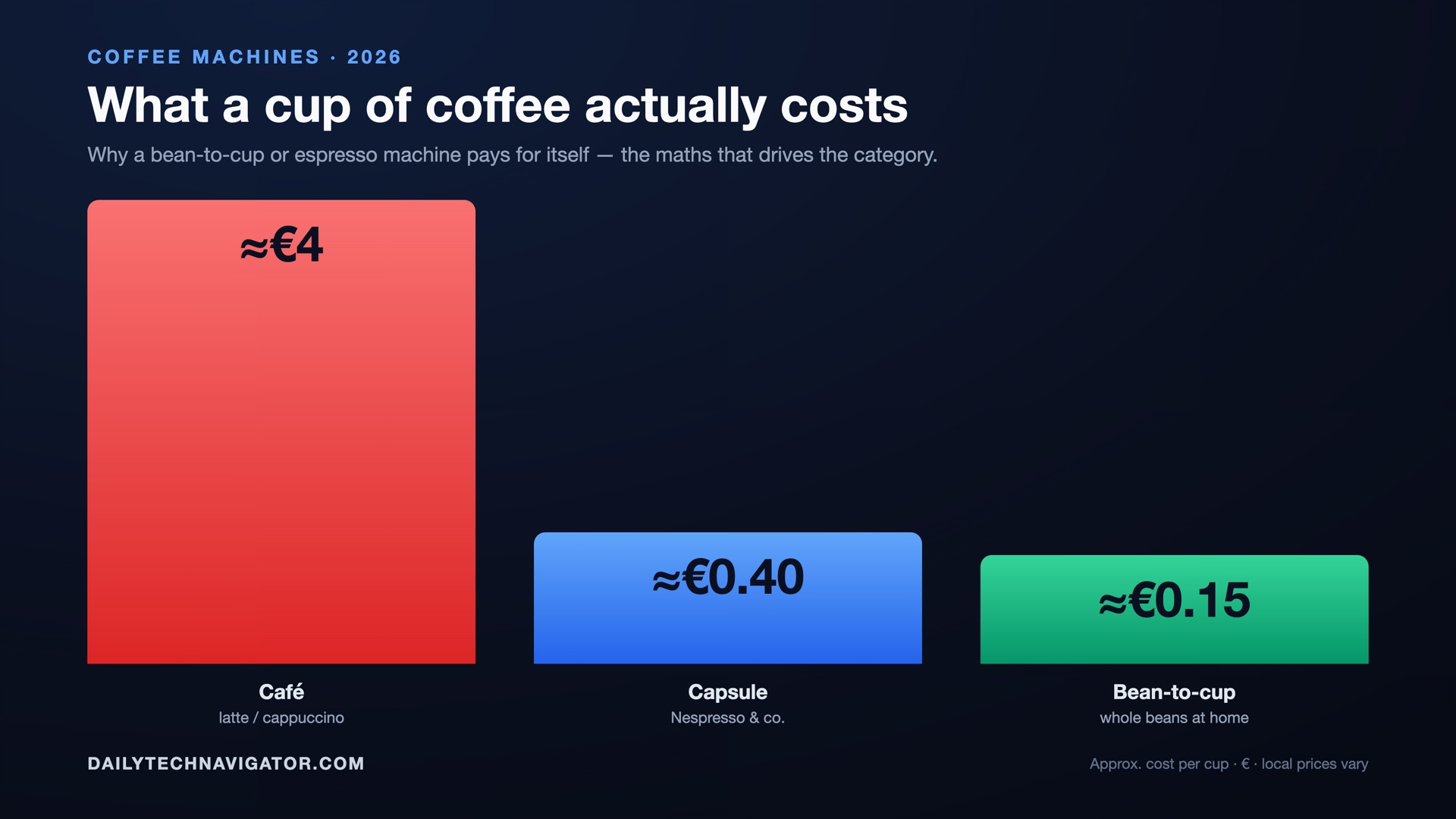
In the US the espresso machine — not the bean-to-cup automatic that dominates Germany — is the default home setup. And the financial case is the same everywhere: a home shot costs about $0.15–$0.20 versus $0.40 a capsule and $4–$5 for a café latte. That gap is the editorial backbone of this guide.
| Model | Price band | Grinder | Boiler / temp | Milk | Best for | Main compromise |
|---|---|---|---|---|---|---|
| De’Longhi La Specialista Opera | ~$600–$800 | built-in conical burr | thermoblock, PID-ish | manual steam wand | Best all-rounder | Bigger countertop footprint |
| Breville Bambino | ~$250–$300 | none | thermojet (fast, stable) | auto + manual froth | Best under $300 | Needs a separate grinder |
| Breville Barista Express Impress | ~$650–$750 | built-in, guided dose | thermojet + PID | manual steam wand | Best one-box starter | Learning curve |
| Breville Oracle Jet | ~$1,200–$1,500 | built-in, auto-tamp | dual heat system | auto steam | Premium, near-automatic | Price |
| Gaggia Classic Evo | ~$450–$500 | none | single boiler | manual steam wand | Enthusiast tinkerer | No grinder, more manual |
Prices are bands at amazon.com as of June 1, 2026; they fluctuate daily and are re-verified each quarter.
Short answer: About $0.15–$0.20 per shot with whole beans at home, versus roughly $0.40 per capsule and $4–$5 for a café latte. A $400–$700 machine often pays for itself within a year against a daily café habit. Add a few cents for electricity and descaler.
That’s the whole financial argument for buying a machine at all — and the more drinks you pull per day, the faster it pays back. It’s also why we lead with cost per cup rather than crema photos: it’s the one objective number that decides whether a machine is worth it for you.
Short answer: A manual espresso machine (the US default) gives more control and usually a better shot, but asks for a grinder, some technique and daily cleaning. A bean-to-cup automatic (push a button, walk away) is the convenience play if you mostly want milk drinks with zero effort. Pick the manual machine if you enjoy the process; the automatic if you want a one-button cappuccino on the way out the door.
A few things separate a machine you’ll still use in three years from one that ends up in a closet:
Short answer: We re-verify prices, availability and new models at the start of each quarter. This page shows price bands at amazon.com, not live prices — that keeps the data honest and complies with Amazon Associates policy. The current price appears when you click through to Amazon.
Our editorial methodology explains how we choose picks, which sources we weight, and what we deliberately don’t do (no in-house hands-on testing, no fabricated star ratings).
This guide covers the US market (amazon.com). For Germany see DE-Version (bean-to-cup focus); for the UK see en-GB version (Sage & co.).
De'Longhi
Current price & reviews on Amazon
Prices & availability may change.

Breville
Current price & reviews on Amazon
Prices & availability may change.

Breville
Current price & reviews on Amazon
Prices & availability may change.
For most US buyers, the De'Longhi La Specialista Opera is the best all-rounder — rich, balanced results and approachable for beginners and enthusiasts alike. The Breville Bambino is the standout under $300, and the Breville Oracle Jet is the premium pick if you want near-automatic convenience with full control. Reviewers at Consumer Reports, Tom's Guide and CNN Underscored converge on this shortlist.
Breville usually wins on ease of use, steady PID temperature control and high-end dual-boiler options; De'Longhi pushes strong value and compact, space-saving designs. For a first 'real' espresso machine the Breville Bambino is the safe pick; for the best balance of price and capability the De'Longhi La Specialista Opera is hard to beat. Both are widely stocked on amazon.com.
Around $0.15–$0.20 per shot with whole beans at home, versus roughly $0.40 per capsule and $4–$5 for a café latte. That gap is the whole financial argument: a $400–$700 machine often pays for itself within a year against a daily café habit. Add a few cents for electricity and descaler.
A built-in grinder (Breville Barista Express Impress) is enough for most people and saves counter space. A separate burr grinder gives finer control and is the upgrade serious users make first — more than upgrading the machine itself. A machine without any grinder (Breville Bambino) only makes sense if you already own one or buy fresh pre-ground.
Check the boiler type (a PID-controlled or thermojet boiler holds temperature better), whether a grinder is included, the water-tank size for your household, and that it's a US 120V model with a standard plug. Also confirm descaler and cleaning tablets for your specific model are easy to get on amazon.com — ongoing maintenance is what keeps a machine alive.
Ultra-cheap pressurized-portafilter machines with no temperature control (sour, inconsistent shots), pod machines if you drink several cups a day (the per-cup cost adds up fast), and any machine without easy access to descaling and replacement parts. Spend the money on a steady boiler and a decent grinder rather than gimmick presets.
Keep Reading
Power & Energy
12V or 24V for a 2000W inverter? We compare current draw (~170A vs ~85A), cable gauge, cost and efficiency — and when 12V is fine vs. when 24V is the clearly better choice.
Smart Home
The best 3D printers under $500 for US buyers in 2026: Bambu Lab A1, A1 Mini, Elegoo Centauri Carbon and Creality K1C compared, with picks and prices.
Power & Energy
How much battery for a PSPS outage? Shutoffs run 24–72 hours. We size it by load — fridge (~1–2 kWh/day), essentials, whole-home — and explain why solar recharge matters for multi-day outages.