How Much Battery Do You Need to Ride Out a PSPS Outage?
How much battery for a PSPS outage? Shutoffs run 24–72 hours. We size it by load — fridge (~1–2 kWh/day), essentials, whole-home — and explain why solar recharge matters for multi-day outages.
Transparency: links marked (*) are affiliate links — if you buy through them we may earn a commission at no extra cost to you. It doesn't change our recommendations.
Last updated: May 2026 · Part of our plug-and-play home backup guide.
When the utility calls a Public Safety Power Shutoff, the question isn’t whether a battery helps — it’s how big a battery you actually need to get through it.
Short answer
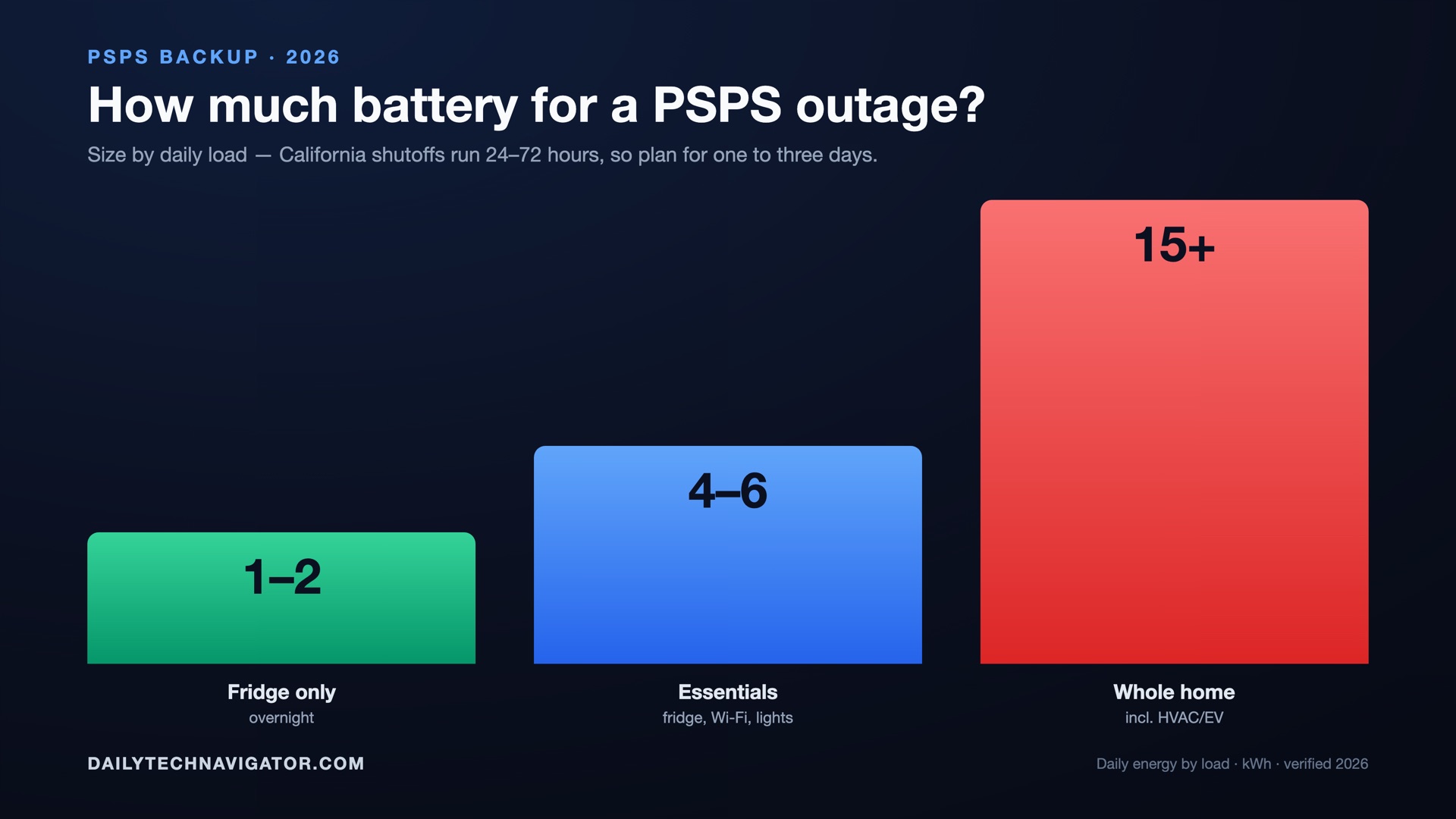
Size it by load and duration. A fridge needs ~1–2 kWh per day, so a 1–2 kWh unit covers one overnight. For essentials (fridge, Wi-Fi, lights, phones) plan on ~4–6 kWh/day — an Anker SOLIX F3800 (3.84 kWh) covers about a day. Since PSPS events run 24–72 hours, add a second battery or solar to recharge for multi-day cover.
How long PSPS outages last
PG&E and other California utilities run PSPS events to reduce wildfire risk, and they commonly last 24–72 hours — occasionally longer in remote areas. That’s the planning horizon: not “a few hours,” but one to three days.
Size by load
| What you’re backing up | Daily energy | Battery to aim for |
|---|---|---|
| Fridge only | ~1–2 kWh | 1–2 kWh (overnight), more for multi-day |
| Essentials (fridge, router, lights, phones) | ~4–6 kWh | 4–6 kWh/day (e.g. 3.84 kWh F3800 + solar) |
| Whole home incl. HVAC/EV | 15+ kWh | fixed install (Powerwall-class) |
Estimate your own fridge with: battery Wh ÷ average fridge watts = hours of runtime.
The ~1–2 kWh/day figure is for a modern, efficient unit. An older or larger fridge-freezer (or a second garage freezer) can pull 3–6 kWh/day — check the appliance’s energy label and size up if in doubt. Underestimating here is the most common reason a backup runs out overnight.
Mind the surge
A fridge compressor draws a brief ~1,500W startup surge even if it only runs at 100–200W. Make sure your battery’s continuous and surge output can handle it — most 1 kWh+ power stations can, but very small units may trip.
Multi-day outages = add solar
For 2–3 day PSPS events, stored capacity alone runs out. A 400W+ solar panel adds roughly 1–2 kWh on a clear day — enough to keep a fridge going night after night. Expandable power stations with solar input are the practical answer for repeat outages.
Which units fit which job — and how to set them up without an electrician — is in our plug-and-play home backup guide. See also: NEM 3.0 explained.
FAQ
How long do PSPS outages last? +
California Public Safety Power Shutoffs typically last 24–72 hours, sometimes longer. Size your backup for at least one to three days, not just a few hours.
How much battery do I need to run a fridge? +
A typical fridge uses ~1–2 kWh per day (100–800W running, with a ~1,500W startup surge). A 1–2 kWh power station keeps a fridge cold overnight; for 2–3 days you'll want more capacity or solar to recharge.
What size for essentials (fridge, router, lights, phones)? +
For fridge + Wi-Fi + lights + phone charging, plan on roughly 4–6 kWh per day. Something like an Anker SOLIX F3800 (3.84 kWh) covers a day of essentials; the EcoFlow DELTA Pro 3 (4 kWh) is the main alternative. Daisy-chain a second unit or add solar for multi-day cover.
Do I need solar to recharge during an outage? +
For outages beyond a day, yes — a 400W+ panel adds roughly 1–2 kWh on a clear day, enough to stretch a fridge through several nights. Without solar you're limited to the battery's stored capacity.
Do I need a permit for a plug-in backup battery? +
No. A plug-and-play battery that powers loads through its own outlets is treated as an appliance — no permit, no interconnection. Hardwiring into your panel (transfer switch) is a different story and needs an electrician.