US Best Overall
Ninja
Air Fryer Pro 4-in-1 (AF141)
- ✓Best Overall — Tom's Guide 2026
- ✓5 qt basket, 4 cooking modes
- ✓Easy-clean non-stick interior
Current price & reviews on Amazon
Prices & availability may change.
The best air fryers in the US for 2026: Ninja Air Fryer Pro 4-in-1 (Tom's Guide best overall), Instant Vortex Plus, COSORI TurboBlaze, Dash Tasti-Crisp and Cuisinart compared — with countertop sizing for US kitchens and 120 V wattage notes.
Transparency: links marked (*) are affiliate links — if you buy through them we may earn a commission at no extra cost to you. It doesn't change our recommendations.
Prices verified at amazon.com on June 1, 2026 — see Editorial Methodology for how we choose and refresh picks.
Affiliate disclosure: As an Amazon Associate we earn from qualifying purchases. If you click through and buy on amazon.com, we receive a small commission at no additional cost to you. Commission rates don’t influence our picks.
Short answer: For most US kitchens, the Ninja Air Fryer Pro 4-in-1 is the best overall choice — Tom’s Guide ranks it #1 for its simple controls, US-friendly countertop footprint and reliable 120 V wattage. The Consumer Reports highest-rated US pick is the Dash Tasti-Crisp DCAF260 for controls and cleaning. Instant Vortex Plus is the best all-around value; COSORI TurboBlaze wins TechGearLab’s family-size lab testing.
Air fryers became the most-bought small kitchen appliance in the US in 2025 and continued through 2026 — for good reason. They preheat in 2 minutes vs. 10 for an oven, fit on standard US countertops, and run reliably on a 120 V outlet. The comparison below lists what currently top-tests on US testing sites (Tom’s Guide, Consumer Reports, TechGearLab, Wirecutter) and what actually fits in a US apartment or family kitchen.
| Model | Capacity | Type | Wattage | Max temp | Footprint | Price band | Best for |
|---|---|---|---|---|---|---|---|
| Ninja Air Fryer Pro 4-in-1 | 5 qt | Single basket | 1,500 W | 400 °F | ~13”×13” | ~$99–$129 | Best US overall (Tom’s Guide) |
| Ninja Foodi MAX 8 qt Dual Zone DZ401 | 8 qt (2×4) | Dual basket | 1,690 W | 450 °F | ~16”×14” | ~$199–$229 | Family + sync finish |
| Instant Vortex Plus 6 qt | 6 qt | Single basket | 1,500 W | 400 °F | ~13”×14” | ~$99–$129 | Best value all-rounder |
| Instant Vortex Slim | 5 qt | Single (narrow) | 1,500 W | 400 °F | ~10”×14” | ~$99–$119 | Small / apartment counters |
| COSORI TurboBlaze 6 qt | 6 qt | Single basket | 1,750 W | 450 °F | ~13”×13” | ~$129–$159 | Family lab-test winner |
| Dash Tasti-Crisp DCAF260 | 2.6 qt | Mini single | 1,000 W | 400 °F | ~10”×10” | ~$59–$79 | Single / studio kitchens |
| Cuisinart TOA-65 Convection Oven AF | 0.6 cu ft | Convection oven + AF | 1,800 W | 450 °F | ~17”×16” | ~$229–$269 | Replaces toaster oven |
Prices are bands at amazon.com as of June 1, 2026; they fluctuate daily and are re-verified each quarter.
Short answer: Probably yes, but measure first. Standard US countertops have 16–18 in of usable depth and most upper cabinets sit 18 in above. A 5–6 qt single basket (Ninja Air Fryer Pro, Instant Vortex Plus) needs ~13 in × 13 in plus 4 in clearance behind for the exhaust vent. An 8 qt dual basket (Ninja Foodi MAX) needs ~16 in × 14 in and won’t fit under most upper cabinets without sliding forward when running.
Apartment dwellers in US cities (NYC, San Francisco, Chicago) often have 14-in counters — the Instant Vortex Slim at 10 in × 14 in is the answer here. Suburban US kitchens with island counters can absorb the larger dual-basket models without issue. The “fits my counter” question is the single biggest source of returns on Amazon.com — measure before ordering.
Short answer: Standard 120 V / 15-amp US outlets handle most air fryers (1,400–1,700 W) just fine — as long as you’re not sharing the circuit. If your kitchen has one 15-amp circuit for the whole counter run, running the air fryer plus coffee maker plus microwave will pop the breaker. Older US homes (pre-1980 wiring) are especially vulnerable. Newer code requires dedicated 20-amp small-appliance circuits — but only above the counter, and only if the contractor wired it correctly.
Practical rule: 5–6 qt single-basket air fryers under 1,500 W are safe on any standard US kitchen outlet. 8 qt dual-basket and convection-oven hybrids drawing 1,700–1,800 W benefit from a dedicated 20-amp outlet, common in newer kitchens. If you’re tripping a breaker repeatedly, downsize the air fryer or call an electrician — don’t run an extension cord.
Short answer: Single basket for 1–3 people, simpler cleaning, lower price (Ninja Air Fryer Pro, Instant Vortex Plus, COSORI TurboBlaze). Dual basket for families of 4+ who want to run two components at different temperatures with sync-finish (Ninja Foodi MAX Dual Zone, Instant Vortex VersaZone). The dual feature genuinely changes weeknight family meals — fries at 400 °F finishing at the same time as chicken at 380 °F.
The compromise is real on dual baskets: bigger footprint, higher entry price ($200+ vs ~$110 for a quality single), more parts to clean. For US apartment kitchens or two-person households, the single basket wins. For US families with kids who don’t want staggered meals, the dual basket pays back in time saved every week.
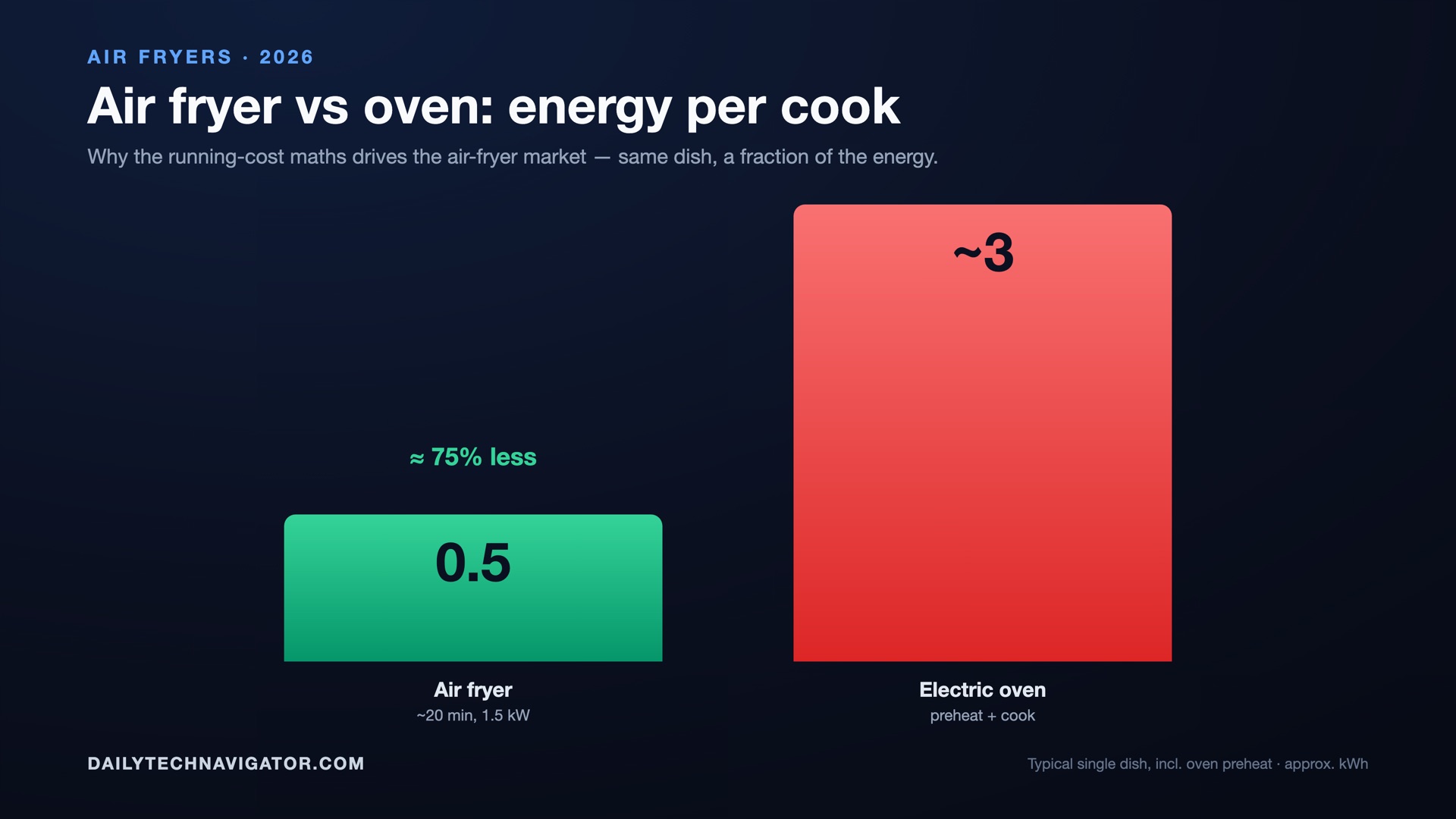
Short answer: Small. A typical 1,500 W air fryer running 20 minutes uses 0.5 kWh; at the US average of $0.16/kWh that’s about 8 cents per use. Compared to a US electric oven (10 min preheat + 0.6 kWh + 2.5–3.5 kWh per use), an air fryer typically saves 60–75% of energy and most of the time for the same dish. Over a year cooking 2–3 times a week, expect $20–$30 in electricity savings. The speed advantage is bigger than the dollar advantage.
Short answer: We re-verify amazon.com prices, ASIN availability, and US testing-site updates (Tom’s Guide, Consumer Reports, TechGearLab, Wirecutter) at the start of each quarter. This page shows price bands, not live prices — Amazon Associates policy requires either timestamped live data or non-time-specific bands. The current US price for you appears when you click through to Amazon.
Our editorial methodology explains how we choose picks, which US test sources we weight, and what we deliberately don’t do (no in-house testing — no kitchen lab, no fabricated star ratings, no “we awarded” rosettes). Corrections welcome via the contact address on our imprint page.
This guide covers the US market (amazon.com). For Germany see the DE-Version, for the UK the en-GB version.
Ninja
Current price & reviews on Amazon
Prices & availability may change.
Philips
Current price & reviews on Amazon
Prices & availability may change.

Dreo
Current price & reviews on Amazon
Prices & availability may change.
Tom's Guide rates the Ninja Air Fryer Pro 4-in-1 as the best overall for US kitchens — simple controls, fits most countertops, runs on a 120 V outlet without tripping breakers. Consumer Reports' highest-rated US pick is the Dash Tasti-Crisp DCAF260 for its controls and easy cleaning. The Instant Vortex Plus is the best value all-rounder, and the COSORI TurboBlaze is the family-size winner in TechGearLab's lab testing.
Most US countertops have 16–18 in of usable depth between the wall and the front edge. A 5–6 qt single-basket air fryer (Ninja Air Fryer Pro, Instant Vortex Plus) needs ~13 in × 13 in of footprint. A dual-basket like Ninja Foodi MAX 8 qt needs ~16 in × 14 in — that's still fine on most counters but doesn't fit under upper cabinets without 4–5 in of vertical clearance for the exhaust vent. Measure before you buy, especially in apartments with shallow counters.
Most US air fryers pull 1,400–1,700 W and run fine on a standard 120 V / 15-amp outlet. The trap is sharing the circuit: if your kitchen has one 15-amp circuit feeding the counter, running the air fryer plus a coffee maker, microwave, or toaster oven will trip the breaker. Larger 8 qt and dual-basket models often draw 1,750–1,800 W and benefit from a dedicated 20-amp outlet — common in newer US homes, often missing in older ones.
Single basket (Ninja Air Fryer Pro, Instant Vortex Plus, COSORI TurboBlaze) is simpler, cheaper and easier to clean — ideal for 1–3 people or anyone who cooks one component at a time. Dual basket (Ninja Foodi MAX, Instant Vortex VersaZone) lets you run fries at 400 °F and chicken at 380 °F simultaneously with sync-finish — the killer feature for families of 4+ who don't want to stagger meals. The trade-off is countertop footprint and a higher entry price.
A typical air fryer at 1,500 W running for 20 minutes uses 0.5 kWh. At the US average of ~$0.16/kWh that's about 8 cents per use. Compared to a conventional electric oven (which takes 10+ minutes just to preheat and uses 2.5–3.5 kWh for the same dish), an air fryer typically saves 60–75% of the energy and most of the time. Over a year of cooking 2–3 times a week, the savings are real but modest — under $30 — and the speed advantage is the bigger win.
Ninja dominates US sales and Tom's Guide / Consumer Reports rankings. Instant (the Instant Pot company) is the value alternative with excellent app integration. COSORI is the family-size lab-test favorite (TechGearLab). Dash makes the cheapest top-rated mini that Consumer Reports picked, ideal for studio apartments and singles. Cuisinart and Breville sit in the premium tier — solid but pricier than the Ninja / Instant value proposition. Avoid no-name brands on Amazon.com without a real US warranty.
Keep Reading
Power & Energy
12V or 24V for a 2000W inverter? We compare current draw (~170A vs ~85A), cable gauge, cost and efficiency — and when 12V is fine vs. when 24V is the clearly better choice.
Smart Home
The best 3D printers under $500 for US buyers in 2026: Bambu Lab A1, A1 Mini, Elegoo Centauri Carbon and Creality K1C compared, with picks and prices.
Power & Energy
How much battery for a PSPS outage? Shutoffs run 24–72 hours. We size it by load — fridge (~1–2 kWh/day), essentials, whole-home — and explain why solar recharge matters for multi-day outages.