NEM 3.0 Explained: How California's Net Billing Tariff Changed Solar Payback
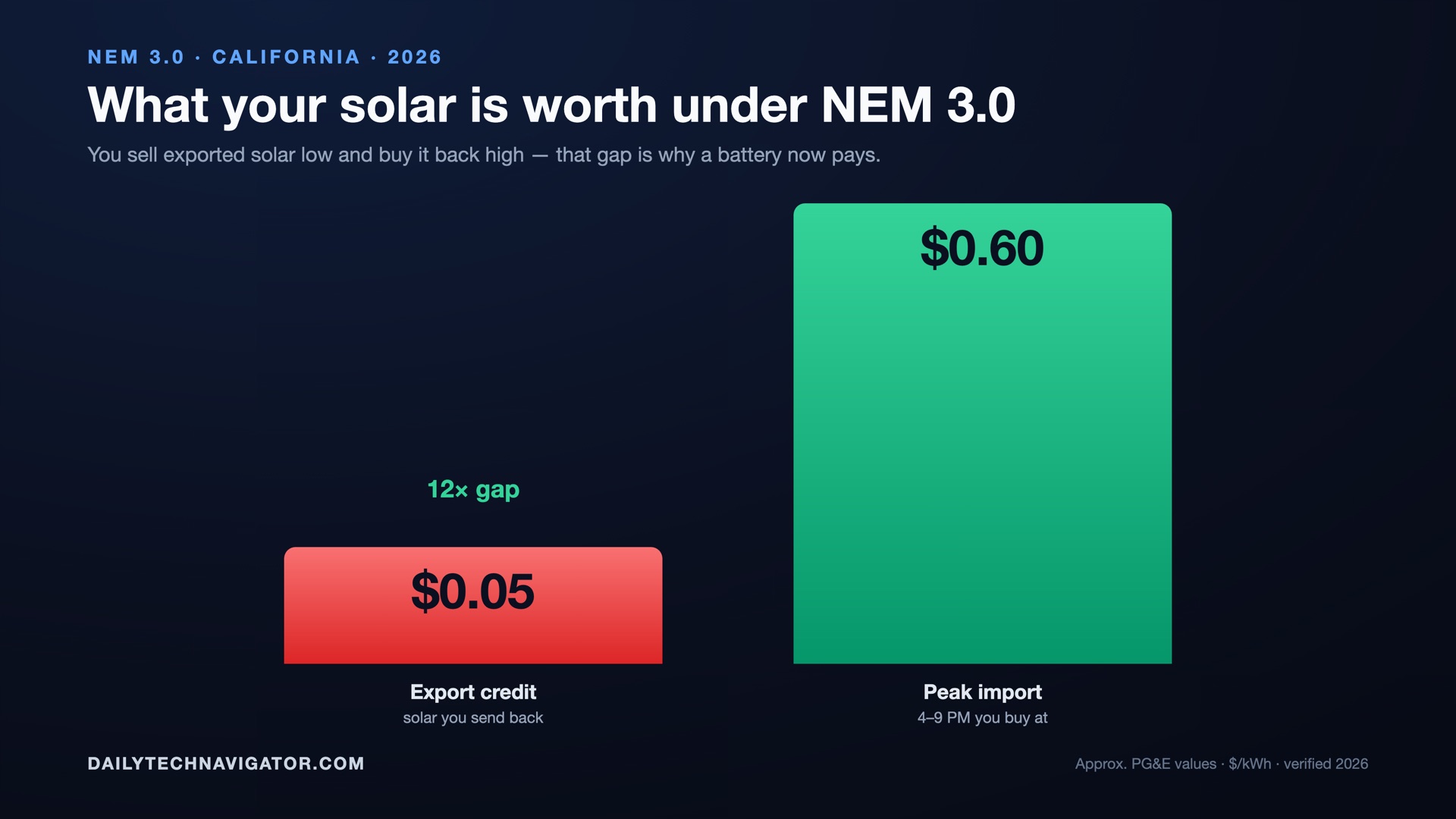
NEM 3.0 explained: California's Net Billing Tariff (since 2023) pays roughly $0.05/kWh for exported solar but charges up to ~$0.60 at peak. We break down what changed and why a battery now makes the difference.
Transparency: links marked (*) are affiliate links — if you buy through them we may earn a commission at no extra cost to you. It doesn't change our recommendations.
Last updated: May 2026 · Part of our plug-and-play home backup for NEM 3.0.
If you’re looking at solar or a home battery in California, “NEM 3.0” is the rule that decides how much your exported power is worth — and it changed the math a lot.
Short answer
NEM 3.0 (California’s Net Billing Tariff) has applied to new solar since 2023. It pays roughly $0.05/kWh for solar you export, while you still buy power back at up to ~$0.60/kWh at peak. Because exporting now pays so little, the value has shifted to storing and self-using your power — which is exactly why a battery makes the difference under NEM 3.0.
What NEM 3.0 (Net Billing) is
It’s the California Public Utilities Commission’s tariff for how rooftop-solar customers of PG&E, SCE and SDG&E are credited for power sent to the grid. Instead of crediting exports at the retail rate (as NEM 2.0 largely did), Net Billing credits them at hourly avoided-cost values — which are low most of the day. The ~$0.05/kWh figure is an annual blended average; the actual hourly credit swings from near-zero at spring midday to over $0.50/kWh during summer-evening peaks.
One important limit: NEM 3.0 applies only to the three big investor-owned utilities. If a municipal utility serves you — SMUD, LADWP and others — you’re under that utility’s own net-metering rules, which are often more generous. Check who your provider is before assuming NEM 3.0 applies.
What changed vs. NEM 2.0
Under NEM 2.0, a kWh you exported was worth roughly what a kWh you imported cost — so a grid-tied system without a battery still paid back well. Under NEM 3.0, the export value collapsed to around a nickel, while peak import prices climbed. Same panels, same sun — a fraction of the credit.
Why a battery now matters
If exporting pays ~$0.05 and peak power costs ~$0.60, the smart move is to keep your own energy instead of selling it: charge a battery from your solar (or cheap off-peak grid) and run your evening loads from it during the 4–9 PM peak. That price gap is where the savings live now.
Are you grandfathered?
Customers who interconnected under NEM 2.0 generally keep those terms for about 20 years from their interconnection date. Only new systems fall under the Net Billing Tariff — so check your interconnection date before assuming NEM 3.0 applies to you.
How a plug-in battery actually exploits this gap — without an electrician or utility paperwork — is in our plug-and-play home backup guide. See also: how much battery you need for a PSPS outage.
FAQ
What is NEM 3.0? +
NEM 3.0 is the common name for California's Net Billing Tariff, the rules for how rooftop-solar customers of the big utilities (PG&E, SCE, SDG&E) are paid for the power they export to the grid. It replaced the older, more generous NEM 2.0.
When did NEM 3.0 start? +
The Net Billing Tariff took effect in April 2023 for new solar interconnection applications. Customers who interconnected under NEM 2.0 keep those terms for a set period.
How much do you get for exported solar under NEM 3.0? +
Far less than before. Export credits follow hourly avoided-cost values that average around $0.05/kWh — while you still pay up to ~$0.60/kWh during the 4–9 PM peak. That gap is the whole point of adding storage.
Does NEM 3.0 make batteries worth it? +
It strengthens the case. Because exporting pays so little, storing your own solar (or cheap off-peak power) and using it during peak is where the value now sits. Model it against your actual rate plan.
Am I grandfathered on NEM 2.0? +
If you interconnected under NEM 2.0, you generally keep those terms for about 20 years from your interconnection date. New systems fall under the Net Billing Tariff.